
Planning a Sikh Destination Wedding is not about chasing Instagram shots. You are trying to move a sacred Sikh ceremony into a foreign country, under resort contracts, airline rules, and guest expectations that often clash with Maryada. This guide walks you, step by step, through how to plan an Anand Karaj abroad in 2025–2026, without cutting corners on Sikh principles, and without walking into the common legal, cost, and weather traps that blow up budgets and timelines.
1. Understanding a Sikh Destination Wedding

A Sikh destination wedding is not a pool-party weekend with a token religious moment tacked on. It is first and foremost a sacramental Anand Karaj that must align with Sikh Maryada, no matter how fancy the venue or how far from home you travel.
Core principles you must preserve
When planning Sikh destination wedding experiences, you must lock in the following from day one:
- Guru Granth Sahib Ji must receive full respect at every step: during transport, in accommodation, and in the ceremony space. No shortcuts because “the airline was strict” or “the resort was confused.”
- Anand Karaj must follow Rehat Maryada:
- All four Laavan, properly conducted.
- Kirtan performed appropriately, not a DJ remix.
- No mixing of non-Sikh rituals into the Anand Karaj itself. No pandit, no vow mash-up, no “fusion ritual” during Laavan.
- No alcohol, tobacco, or meat anywhere near Guru Granth Sahib Ji or within the Anand Karaj space. Not in the next room “just for convenience,” not in the back during setup.
- Modesty and decorum for everyone present: head coverings, shoes removed, and behavior that reflects understanding that this is a sacred ceremony.
Decide early and be brutally honest with yourselves: is your priority a destination party with a symbolic ceremony, or a destination Anand Karaj that stays true to Sikh principles?
Your answer affects everything: which country even makes sense, which venues qualify, what dates work, and how your entire schedule runs. Couples that dodge this question usually end up fighting with family and resort managers six weeks before the event.
2. Legal vs Sacramental: Structuring Your Marriage Properly

For most Sikh couples, the Anand Karaj is what actually feels like “the wedding.” Governments do not see it that way. Every country has its own legal marriage requirements, and mixing them into your destination plans can create last-minute chaos if you are not realistic.
Two common structures
Civil registration at home, Anand Karaj abroad (most practical)
- You handle the entire legal marriage process in your home country before you travel.
- The destination trip focuses on the Anand Karaj, reception, and family celebrations.
- You avoid wrestling with foreign bureaucracy, translated documents, and city halls that barely know how to spell your names.
- This tends to work best for couples in the UK, Canada, US, Australia, and Europe, where civil registration is straightforward.
Civil registration + Anand Karaj in the destination country
- Some couples insist on legally marrying at the destination city hall or court.
- This usually requires:
- Birth certificates, single-status affidavits, notarizations, translations, and sometimes apostilles.
- Extra on-site time, typically 1–3 business days before any ceremonies, just to sit in offices and wait for stamps.
- You also need to verify whether the local gurdwara can register marriages with the state. Outside the UK and parts of Canada, that is rare.
I strongly advise that for 2026-2027, most Sikh couples complete their legal ceremony at home 2–8 weeks before the trip and let the destination be about the Anand Karaj and celebrations. It reduces visa issues, removes pressure around foreign paperwork, and gives you leverage if flights or weather force date shuffles.
3. Where Can You Have a Sikh Destination Wedding?
Not all “destination wedding hotspots” are built for proper Sikh ceremonies. Some spots are pure marketing, with zero Sikh infrastructure behind the glossy photos. Below is a realistic look at popular countries in 2025–2026.
3.1 Sikh Wedding in Mexico
Cities: Cancun, Riviera Maya, Playa del Carmen, Tulum, Cabo San Lucas.
Gurdwara availability:
- In the main resort zones, you will almost never find a formal gurdwara nearby.
- Most “Sikh weddings” advertised by resorts here are symbolic events. Often they use recorded kirtan, a local officiant, and decor that looks vaguely Punjabi, but no full Anand Karaj.
- However, you can work with a certified destination wedding planner (like us) to ensure the Guru Granth Sahib ji can be available for your wedding and we will also book your Granthi.
Key challenge:
- Many resorts do not fully understand Sikh requirements. They will try to place bars too close, suggest moving chairs in and out around the palki, or refuse to restrict meat or alcohol in adjacent spaces. You must push contracts to clearly separate religious spaces and party areas.
3.2 Sikh Wedding in Italy
Cities: Lake Como, Tuscany, Amalfi Coast, Rome.
Gurdwara availability:
- Formal gurdwaras exist mostly in industrial and urban zones, typically in northern Italy, not in your postcard-style wedding areas.
- In destination zones like Lake Como or Amalfi, you are usually far from a local gurdwara.
Practical route:
- Most couples handle their Anand Karaj in the UK or Canada where gurdwara, family, and legal processes are simple, then do a “wedding blessing,” vow ceremony, or symbolic event plus reception in Italy.
- If you insist on a proper Anand Karaj in Italy, you will probably need to fly in your own Granthi and ragi, arrange transport of Guru Granth Sahib Ji, and negotiate a suitable venue.
3.3 Sikh Wedding in Thailand
Cities: Phuket, Krabi, Hua Hin, Koh Samui, Bangkok.
Gurdwara availability:
- Bangkok and some other major centers have established gurdwaras, serving sizeable Sikh and Punjabi communities.
- Beach islands like Phuket or Koh Samui rarely offer local gurdwaras.
Possible plan:
- Conduct the Anand Karaj at a Bangkok gurdwara, then travel with your guests to an island for your reception and parties.
- Alternatively, fly in a Granthi and ragi and set up a proper ceremony space in a resort ballroom or covered pavilion. Never directly on open sand, where wind, heat, and foot traffic make proper maryada difficult.
Weather warning:
- Thailand runs on competing monsoon systems.
- Phuket/Krabi side: heavy rains commonly from May to October.
- Koh Samui side: heavier rains October to December.
- You must book an indoor backup for Anand Karaj even when the brochure claims “dry season.” Sudden storms are normal.
3.4 Sikh Wedding in Dubai / UAE
Gurdwara availability:
- Guru Nanak Darbar Dubai is a major, purpose-built gurdwara with experience hosting Sikh destination weddings and handling diverse guest lists.
Advantages:
- Strong existing track record with Sikh weddings.
- Airline connectivity is excellent from Europe, North America, and Asia.
- Policies and expectations are clear. Their team is used to coordinating with planners and explaining their rules.
Considerations:
- Alcohol laws are clear, so separating Anand Karaj and reception is actually easier than in many Western cities.
- Peak season from November to March is expensive and books quickly. Hotel rates jump sharply, and you compete with conferences and other weddings.
3.5 Sikh Wedding in Canada or UK as a “Destination”
If you live elsewhere (e.g., US, Australia, Middle East), cities like Vancouver, Toronto, London, and Birmingham operate as de facto destination hubs:
- Multiple large gurdwaras that run Anand Karaj regularly and already understand full-scale Sikh wedding logistics.
- Punjabi/Sikh vendors who know exactly what a Sikh destination wedding requires, from dholis to caterers familiar with langar protocols.
- Clear legal marriage pathways: gurdwaras and local register offices know the drill.
- Far less risk around transporting Guru Granth Sahib Ji long-haul, especially if family elders are concerned about maryada.
4. Religious Requirements & Guru Granth Sahib Ji Logistics
This is the part couples underestimate the most. The spiritual core of your wedding lives here, and the responsibility is heavy.
4.1 Using a local gurdwara vs private setup
Local gurdwara at destination
- This is usually the safest way to protect maryada.
- Common requirements:
- Formal or informal membership or a clear donation procedure.
- Policies on mixed-faith ceremonies and pre-marital Anand Karaj, which may be stricter than your family expects.
- Dress code and head covering rules enforced for all guests, not just the elders.
- Ask specific, direct questions:
- “Do you host Anand Karaj for non-local residents?”
- “What are your expectations for 2025–2026 regarding mixed-faith couples and Rehat Maryada?”
- “What donation range is appropriate, and what does that include?”
Private Anand Karaj at a resort or villa
- You need:
- A committed Granthi and ragi jatha at your location (easiest) or find one willing to travel and uphold full maryada.
- Zero compromise on how Guru Granth Sahib Ji is treated, even when resort staff try to push for convenience.
- A clean, covered, elevated space for the palki, with proper flooring and climate control.
- Many families choose to bring a saroop of Guru Granth Sahib Ji from home. That sounds simple on paper. In reality, it demands constant seva, discipline, and responsibility throughout the trip.
- You need:
4.2 Transportation of Guru Granth Sahib Ji
You cannot treat this like moving luggage. You are responsible for upholding sanctity in spaces that were never designed for this.
Airline travel:
- You cannot check Guru Granth Sahib Ji as luggage. That is non-negotiable.
- You must arrange hand-carry with the airline well in advance, including space allocation and security handling.
- Multiple responsible sewadars must travel with Guru Granth Sahib Ji, stay alert, and maintain chaur sahib and security presence through each transit point.
Accommodation:
- Allocate a dedicated, clean room from the moment Guru Granth Sahib Ji arrives until departure.
- No alcohol, no tobacco, and no non-veg inside that room at any time. That includes staff bringing food or housekeeping.
- Provide a proper bed or platform, rumale, chaur sahib, and a lockable door. Not a makeshift coffee table in a regular guest room.
If your family cannot maintain that level of discipline, I strongly advise one of two routes:
- Use a local gurdwara in the destination city that already has Guru Granth Sahib Ji present and systems in place; or
- Hold the Anand Karaj at home, then keep the destination trip for reception and related events only.
5. Schedule & Flow of Events
A clean schedule keeps religious events and party energy from colliding. When you mix them, you invite disrespect, delay, and family clashes.
Typical 3–4 day structure
Day 1 – Arrivals & Welcome Dinner
- Guest arrivals, check-in, and recovery from flights.
- Informal welcome, simple dinner or drinks (if you allow), and early night for those with jet lag.
Day 2 – Maiyan / Haldi & Sangeet
- Morning:
- Maiyan/haldi ceremonies and choora, if your family observes these.
- Evening:
- Sangeet with performances, DJ, and alcohol only if you have chosen to include it.
- Do not place any religious items, scriptures, or paths in the same room where alcohol is served. Not even “just on a side table.”
Day 3 – Anand Karaj
- Early morning:
- Guests gather roughly 1–2 hours before ceremony time.
- Offer a simple breakfast or langar-style meal. Nothing too heavy, especially in humid climates.
- Anand Karaj:
- Kirtan, Laavan, Ardas, hukamnama, then family blessings and photos.
- Afternoon:
- Downtime. Let people rest, hydrate, and change.
- Evening:
- Reception in a different space, at a different time, with Guru Granth Sahib Ji already returned to Sachkhand or the gurdwara.
Day 4 – Farewell Brunch
- Unhurried brunch.
- Optional excursion for those staying longer, and staggered departures.
Consultant Advice: Do not cram Anand Karaj and a late-night open-bar reception in the same ballroom with a one-hour turnover. That setup usually ends in rushed teardown while guests wander around in semi-formal outfits.
6. Budget: What a Sikh Destination Wedding Costs (2025–2026)
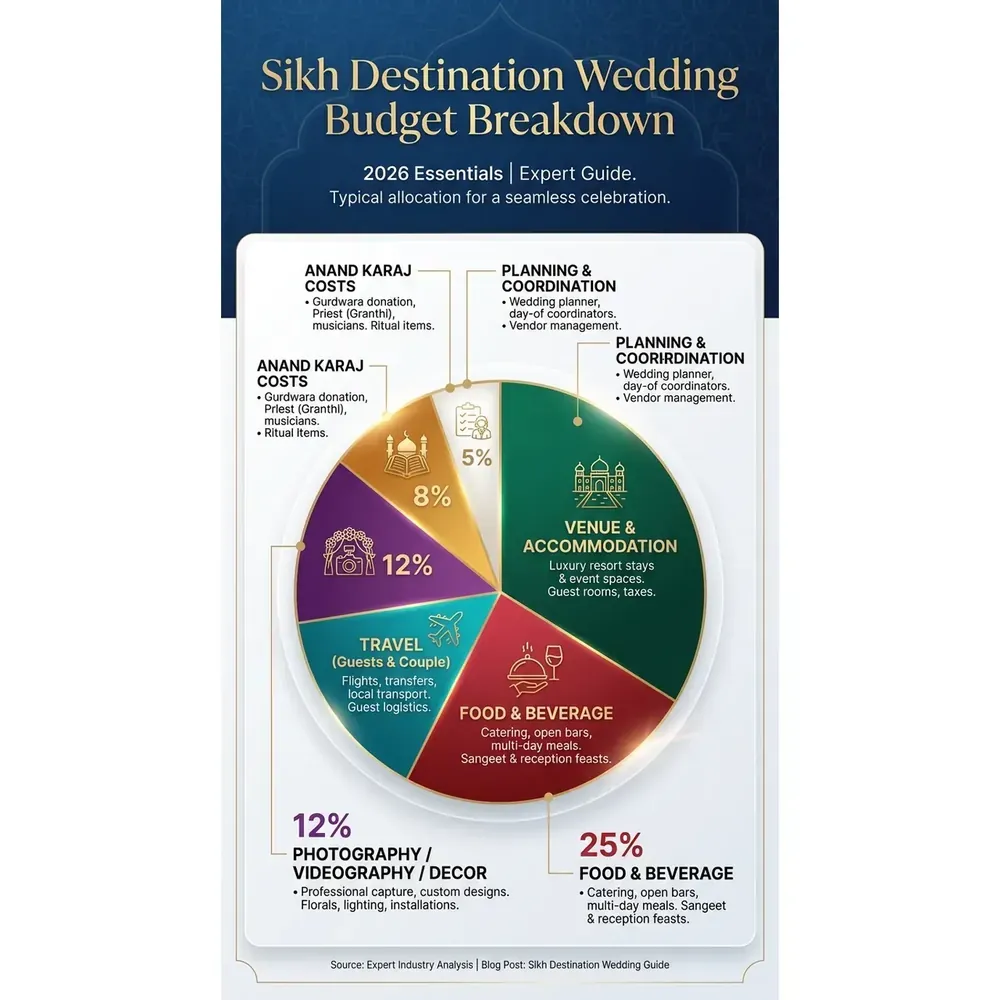
For 80–150 guests, you are not planning a “cheap hack.” You are essentially running a multi-day event in a foreign country with added religious logistics. Here is what that realistically looks like.
6.1 Core cost components
Resort / Venue & Accommodation (3–4 nights)
- Mid-range all-inclusive resort (Mexico, Thailand):
- Roughly USD $250–$450 per person per night, depending on season and view category.
- Luxury 5-star property or Italian villa:
- Around USD $500–$1,200+ per room per night.
- Once you factor in events and taxes, a 3-night stay for 100 guests typically lands between USD $75,000–$150,000 for rooms and core event spaces combined.
- Mid-range all-inclusive resort (Mexico, Thailand):
Anand Karaj-Related Costs
- Granthi + ragi jatha travel, accommodation, and honorarium:
- Roughly USD $4,000–$12,000 total, varying with distance, number of musicians, and class of travel.
- Gurdwara donation (if using a local gurdwara):
- Expect USD $500–$3,000+ depending on location and the scale of your wedding.
- Palki, decor, and sound system setup:
- Usually USD $1,500–$5,000, more if you chase high-end decor.
- Granthi + ragi jatha travel, accommodation, and honorarium:
Food & Beverage
- All-inclusive resort plans may include most standard meals, but:
- Private events with upgraded menus, late-night snacks, or premium open bars typically add USD $60–$200 per person per event.
- All-inclusive resort plans may include most standard meals, but:
Travel
- Couple and immediate family flights:
- Roughly USD $8,000–$25,000+, depending on distance, class of service, and how many relatives you are subsidizing.
- Guests usually pay their own flights. Make this crystal clear early, or you will deal with out-of-pocket surprises.
- Couple and immediate family flights:
Photography, Videography & Decor
- Professional team that understands Sikh ceremonies:
- Around USD $5,000–$20,000, with higher rates in Europe and North America.
- Decor for Anand Karaj, Sangeet, and Reception:
- Typically USD $10,000–$60,000+, heavily influenced by floral choices and custom builds.
- Professional team that understands Sikh ceremonies:
Planning & Coordination
- Destination Sikh wedding planner:
- Often USD $5,000–$20,000, or 10–15% of the total budget.
- Be wary of planners who ignore religious rules to push “wow moments.” Cheap now, expensive later.
- Destination Sikh wedding planner:
Typical budget range:
For 80–150 guests, a serious Sikh destination wedding in 2025–2026 usually falls between USD $90,000 and $300,000, depending on country, season, and luxury level.
Add outside vendor fees to your mental math: many all-inclusive resorts charge USD $500–$1,000 per vendor when you bring your own photographer, DJ, or decor company. Ignore that in negotiations, and you can lose another five figures quietly.
7. Timelines & Deposit Structure
You are dealing with international flights, visas, religious teams, and resorts that overbook. A casual timeline guarantees stress.
12–18 months before
- Decide, clearly: Anand Karaj at home or abroad?
- Shortlist 2–3 countries and 4–6 potential venues or resorts.
- Start direct conversations with:
- Gurdwara committees at destination and/or at home.
- Potential Granthis and ragi jathas willing to travel.
- Set a realistic budget range, not a fantasy number.
10–14 months before
- Confirm Granthi and ragi availability and their travel plan.
- Lock in your venue and confirmed wedding dates.
- Expect to pay 20–30% deposits on estimated room and event costs.
- Confirm your planner if you are using one. Last-minute planner hires usually just fight fires.
- Draft guest list and start save-the-date process, including basic visa guidance.
8–10 months before
- Secure photographer, videographer, DJ or band, and decor team.
- Start firm discussions on menus and alcohol policies for each event. Put religious restrictions in writing.
6–8 months before
- Send formal invitations, particularly for guests who need visas or longer lead-times.
- Confirm room block details, cut-off dates, and penalties for unused rooms.
- Review payment schedule:
- Many resorts require 50–70% of the total to be paid by about 60 days before the event.
- Some also require prepayment for banquets and outside vendor fees.
3–4 months before
- Finalize ceremony program, order of events, and decor concepts.
- Arrange head coverings for non-Sikh guests: simple rumals, scarves, or disposable options.
- Draft seating plans and room allocations so elders are not climbing stairs or walking long distances.
1–2 months before
- Lock in final guest headcount.
- Monitor weather for your specific dates: storms, hurricanes, monsoon patterns, and sargassum reports.
- Reconfirm airport transfers, Granthi and ragi flights, and accommodation details. Check names and spellings against passports to avoid check-in issues.
8. Cultural Etiquette & Guest Management
Many of your destination guests may attend their very first Anand Karaj at your wedding. If you do not educate them, they will guess. Poorly.
Key etiquette points to communicate
Head coverings:
- Mandatory for everyone during Anand Karaj, regardless of background.
- Provide simple rumals, scarves, or bandanas at the entrance, with clear volunteers guiding people.
Shoes:
- Removed before entering the ceremony area, not at the last step. Arrange labeled racks or a staffed shoeroom so guests are not panicking about expensive heels.
Dress code:
- Modest clothing that allows people to sit comfortably on the floor if floor seating is used.
- If you provide chairs for elders and those who cannot sit on the floor, state that explicitly so guests do not feel anxious.
Behavior:
- No loud conversations, no roaming selfies during Laavan, and minimal phone use.
- Provide a simple one-page explanation of the ceremony’s flow and meaning, especially for non-Sikh guests, either printed or via QR code.
I strongly advise preparing a one-page guest guide that you send by email a month out and place in welcome bags on arrival. That single sheet cuts down confusion, reduces accidental disrespect, and keeps you from playing schoolteacher on your own wedding day. If you’re also planning destination events like a welcome party, you can draw on ideas from this destination wedding welcome party guide to set expectations clearly.
9. Weather, Seasonality, and Risk Management
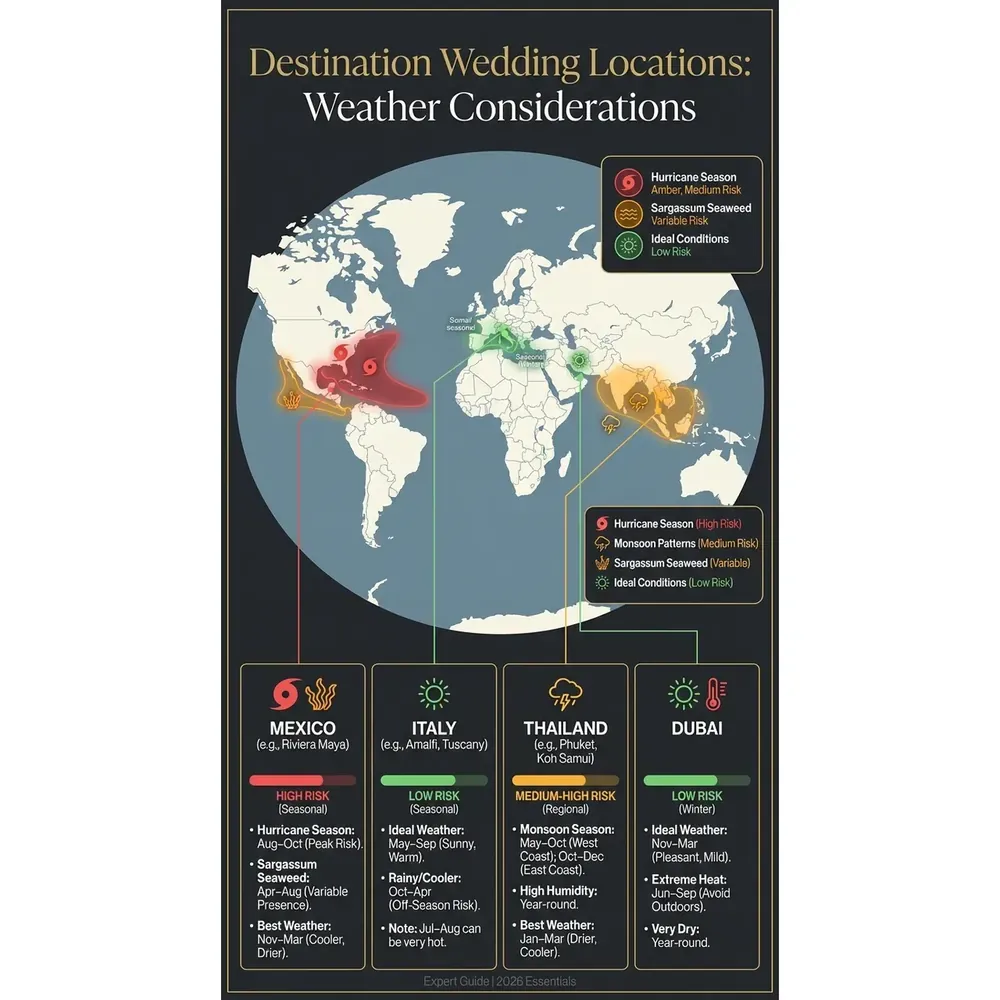
Weather destroys more destination wedding plans than almost any other factor, especially for outdoor-minded couples. You cannot rely on a brochure’s “best season” line.
9.1 Weather Risks for Popular Sikh Destination Wedding Locations
Mexico & Caribbean:
- Hurricane season: June–November, with peak intensity August–October.
- Sargassum seaweed: usually April–September, but can shift year to year.
- High season with generally better conditions: December–April, but with higher prices and tighter availability.
Italy / Mediterranean:
- Best wedding windows: May–June and September–early October.
- July–August: very hot, packed with tourists, and often overpriced.
- Winter: many coastal venues run reduced operations or close large sections.
Thailand:
- West coast (Phuket/Krabi): better from November–April.
- East coast (Koh Samui area): generally better from January–August, with heavier rains around October–December.
Dubai / UAE:
- Comfort window: November–March. Outdoor events are feasible and pleasant.
- June–September: extreme heat. Many outdoor functions quickly become unsafe for elders and children.
9.2 Risk mitigation
- Always secure an indoor backup for Anand Karaj, even if your dream is an oceanfront or garden setting.
- Avoid scheduling Anand Karaj in the midday heat window, especially in tropical climates. Early morning timings work better for comfort and decor conditions.
- Review your contracts and wedding insurance (if purchased) to make sure they cover:
- Weather disruptions and postponements.
- Venue closures or regional emergencies.
- Rebooking or partial refunds if hurricanes, floods, or other major events force a date change.
For additional protection on the travel side, consider learning about destination wedding travel insurance so your flights and deposits are better covered.
10. Working with a Sikh Wedding Planner
A planner who understands Anand Karaj destination weddings is not a luxury add-on; they are the firewall between you and a series of avoidable mistakes.
You may also find it helpful to compare roles using this breakdown of a destination wedding planner vs. destination wedding travel agent, especially if you’re unsure which type of professional you really need.
What they should handle for you
Coordination with the resort about:
- Clear separation between Anand Karaj spaces and any area where alcohol is served.
- Sound systems that handle live kirtan without crackling, echo, or distortion.
- A respectful layout for the palki, shoe area, and langar or breakfast setup, including staff briefings about head coverings and shoes.
Liaison with gurdwara or Granthi:
- Confirming exact timings, ceremonial steps, and any restrictions for mixed-faith or out-of-town couples.
- Organizing translation or short explanations for guests who do not understand Punjabi, if you want that included.
Timelines and deposits:
- Building realistic schedules that factor in setup, teardown, and religious protocols.
- Tracking deposit deadlines and payment structures with vendors and venues so you do not trigger automatic cancellations.
Vendor management:
- Ensuring decor, AV, and photography teams understand head covering rules and when shoes must come off.
- Managing outside vendor fees at resorts so you do not get hit with surprise charges a week before the flight.
11. Sample Itinerary for a 4-Day Sikh Destination Wedding

To make this practical, here is a sample 4-day structure for an Anand Karaj destination wedding in 2026, in a place like Mexico or Thailand.
Day 1 – Arrival & Welcome
- Afternoon:
- Guests arrive, check in, sort out currency and Wi-Fi.
- Evening:
- Relaxed welcome mixer with snacks and non-heavy drinks.
- No formal ceremonies. Let people catch their breath.
Day 2 – Pre-Wedding Functions
- Morning:
- Haldi/maiyan and family choora ceremony, typically in a private outdoor or semi-outdoor space.
- Afternoon:
- Free time: pool, spa, or local exploring.
- Evening:
- Sangeet with performances, DJ, and optional alcohol service.
- No religious items or paths in this room. Keep the space clearly “non-ceremonial.”
Day 3 – Anand Karaj & Reception
- 6:30–7:30 AM:
- Light breakfast for guests. Tea, coffee, fruit, and simple options.
- 8:00–10:30 AM:
- Anand Karaj with full kirtan, Laavan, Ardas, hukamnama, and any short announcements or explanations.
- 10:30 AM–12:00 PM:
- Family photos and blessings.
- If you plan a dhol welcome or group photos outside, do it after Guru Granth Sahib Ji has been respectfully taken back to the Sachkhand room or gurdwara.
- Afternoon:
- Rest and glam time for couple and guests. Hair, makeup, and outfit changes.
- 6:00–7:00 PM:
- Sunset cocktail hour at a new location, completely separate from the Anand Karaj space.
- 7:00–11:30 PM:
- Reception with speeches, dinner, and dancing.
Day 4 – Farewell
- Late morning brunch so people can sleep in after the reception.
- Optional group excursion for those staying longer.
- Staggered departures based on flight timings and onward travel.
To keep yourself organized across all of these moving parts, it can help to adapt a master list like this ultimate destination wedding checklist to the specific needs of a Sikh Anand Karaj.
Frequently Asked Questions
Can we have a Sikh destination wedding with a full Anand Karaj on the beach?
Trying to set up a full Anand Karaj directly on the sand is usually a bad idea. Wind, heat, sand, and foot traffic make maintaining maryada and cleanliness extremely hard. A better compromise is a covered, raised platform or pavilion near the beach, with a solid, clean floor, shade, and controlled access. You still get the sea nearby, without compromising respect.Is it acceptable to do our legal marriage at home and only the Anand Karaj at the destination?
Yes. Many couples in 2025–2026 handle the civil/legal marriage at home, then treat the destination Anand Karaj as the core of their union. It simplifies paperwork, avoids foreign registries and translation hassles, and makes rescheduling slightly easier if flights or weather shift.How far in advance should we book a Granthi and ragi jatha for an overseas Anand Karaj?
Plan on 6–12 months in advance as a minimum, especially for peak months and long-haul destinations. You must cover flights, accommodation, visas (where required), and an appropriate honorarium. Popular jathas fill their calendars quickly; last-minute scrambling often leads to compromises.Can alcohol be served at a Sikh destination wedding?
Yes, but never in proximity to Guru Granth Sahib Ji. Alcohol must stay completely separate from the Anand Karaj and any space where Guru Granth Sahib Ji is present. In practice, that means serving alcohol only at events like sangeet and reception, in different venues and at different times, after Guru Granth Sahib Ji is respectfully taken to Sachkhand or back to the gurdwara.What should non-Sikh guests know before attending the Anand Karaj abroad?
Make sure they understand that:- Everyone will remove shoes and cover their heads before entering the ceremony space.
- Modest, comfortable clothing is expected, suitable for sitting or at least respectful if chairs are provided.
- They should sit quietly, avoid using phones, and follow the flow of the ceremony as explained by the Granthi or MC.
A short written guide or a quick explanation before Laavan keeps guests informed and relaxed instead of confused.
Is it better to use a local gurdwara at the destination or bring Guru Granth Sahib Ji to the resort?
From a religious standpoint, using a local gurdwara is usually easier, safer, and more respectful. Transporting Guru Granth Sahib Ji across borders is a major responsibility that demands sewadars, constant care, and strict discipline. If your family cannot maintain that standard, arrange the Anand Karaj in a gurdwara (either at home or in your destination city) and keep the resort strictly for receptions and parties.What is a realistic budget for a Sikh destination wedding for about 100 guests in 2025–2026?
For around 100 guests, a realistic total budget usually sits between USD $120,000 and $250,000, depending on the country, resort level, number of events, decor expectations, and whether you are flying in Granthi, ragi, and other vendors. That figure typically includes venue, accommodation, core events, decor, photography, videography, and Anand Karaj-related costs, but does not include most guests’ own flights or their personal spending.
If you’re still deciding between specific regions, resources like this overview of affordable destination wedding locations can help you align Sikh requirements with realistic budgets and venues.
Leave a Reply