
A Kenya 7 day safari itinerary can absolutely deliver serious Big Five sightings, long golden savannahs in the Masai Mara, and Kilimanjaro on the horizon without leaving you exhausted by back‑to‑back marathon drives. Below you’ll find three field‑tested routes, honest drive times, realistic cost brackets, and candid advice on when to pay for flights instead of enduring the longest road legs.
Is 7 Days Enough for a Kenya Safari?
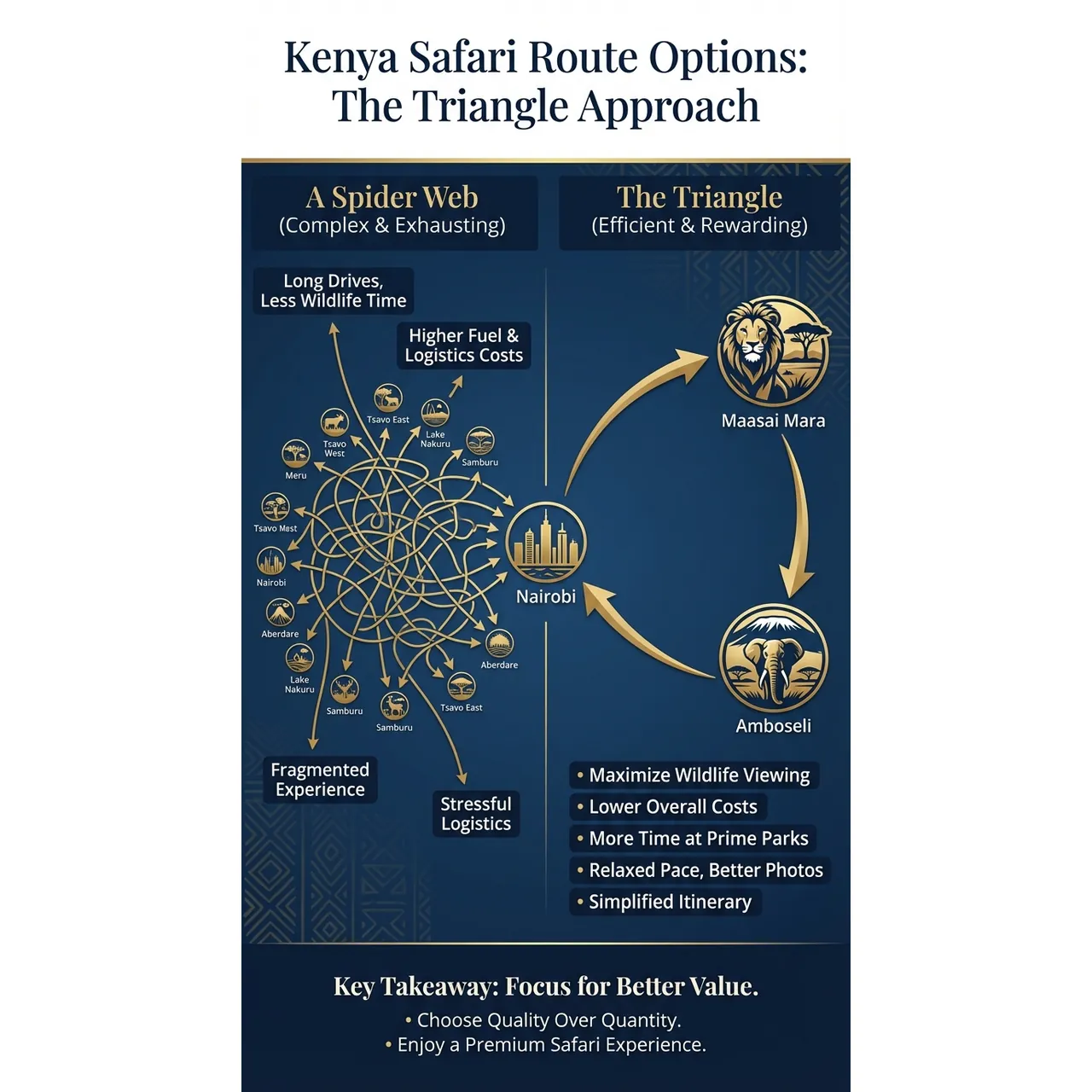
Yes. 7 days is enough for a Kenya safari if you plan like a strategist, not a collector of park names.
What you can realistically do in 7 days:
- Spend 4–5 nights in the Masai Mara or another serious big‑game area.
- Add Amboseli for elephants and Kilimanjaro, or Lake Nakuru/Naivasha for rhinos and a boat safari.
- Log 10–12 game drives and still have time to shower, upload photos, and breathe.
What you should not try to fit into one week:
- Masai Mara plus Amboseli plus Samburu plus Tsavo.
- More than 3 different bases. That usually turns into a blur of packing, dawn departures, 5–7 hour drives, and less time with the wildlife.
Treat your Kenya 7 day safari plan as a triangle, not a spider’s web: Nairobi + 2 prime regions. Sometimes 3, but only when they sit reasonably close or you fly.
How to Choose Your 7 Day Kenya Safari Route
The Main Safari Regions to Consider (Kenya 7 Day Safari Itinerary Options)
Masai Mara
- Best for: Big cats, the Big Five, and the Great Migration (roughly Jul–Oct).
- Why include it: High predator density, open grasslands that make sightings easier, strong light for photography.
- Reality check: It anchors almost any best 7 day Kenya safari itinerary for first timers. Skipping it is a deliberate choice, not an accident.
Amboseli
- Best for: Big, relaxed elephant herds and classic Mount Kilimanjaro views.
- Key nuance: You can see the mountain early morning, then it often hides behind cloud and haze. Late dry‑season months can be harshly dusty.
- Ideal add‑on: Works very well with the Mara on a mixed fly‑in 7 day Kenya safari route.
Lake Nakuru / Lake Naivasha
- Best for: Rhinos (especially at Nakuru), varied birdlife, and non‑vehicle time (boat rides, light walking).
- Good choice: When you want diversity and to avoid the flight cost of adding Amboseli.
Samburu
- Best for: “Northern specials” like Grevy’s zebra, plus dry, rugged landscapes.
- Where it fits: Better on itineraries longer than 7 days, or as a trade‑off choice instead of Amboseli for people who have already done the basics.
Tsavo East/West
- Best for: Big open country with relatively fewer vehicles, ideal if you are road‑tripping in or out of the coast.
- Caution: It usually sits too far for most realistic 7 day Kenya safari itineraries with drive times that don’t dominate the schedule.
Key Decisions That Shape Your Itinerary
Before locking in a Kenya 7 day safari tour, decide the following up front:
Road vs fly‑in vs mixed
- Road only: Cheapest, best if money is tight. But expect long, tiring travel days and some sections that are slow and uneven under wheel.
- Fly‑in: Fast and comfortable, gives you more time in the field, but raises the 7 day Kenya safari cost noticeably.
- Mixed: Often the smartest play. Drive the short links, fly the one or two most demanding sectors (for example, Amboseli to Mara).
Number of bases vs number of parks
- 2–3 bases is the sweet spot for a week.
- Going to 4+ bases only really works when the distances are short and you’re consciously trading game‑drive time for variety.
Budget level (per person, sharing)
(indicative only; everything moves with season, exchange rate, and park fees)- Mid‑range: $3,000–$6,000.
- Luxury: $6,000–$10,000+.
- These numbers usually exclude international flights but include most core safari costs in Kenya.
Best Time to Visit
- Peak migration (Jul–Oct) vs big‑cat months (Jan–Mar) vs value‑heavy green season (Nov, parts of Apr–Jun).
Best for
- First‑timers hungry for big cats and classic views.
- Families who want manageable drive lengths and child‑friendly camps with pools and space to roam between drives.
3 Expert 7 Day Kenya Safari Itineraries (With Variations)
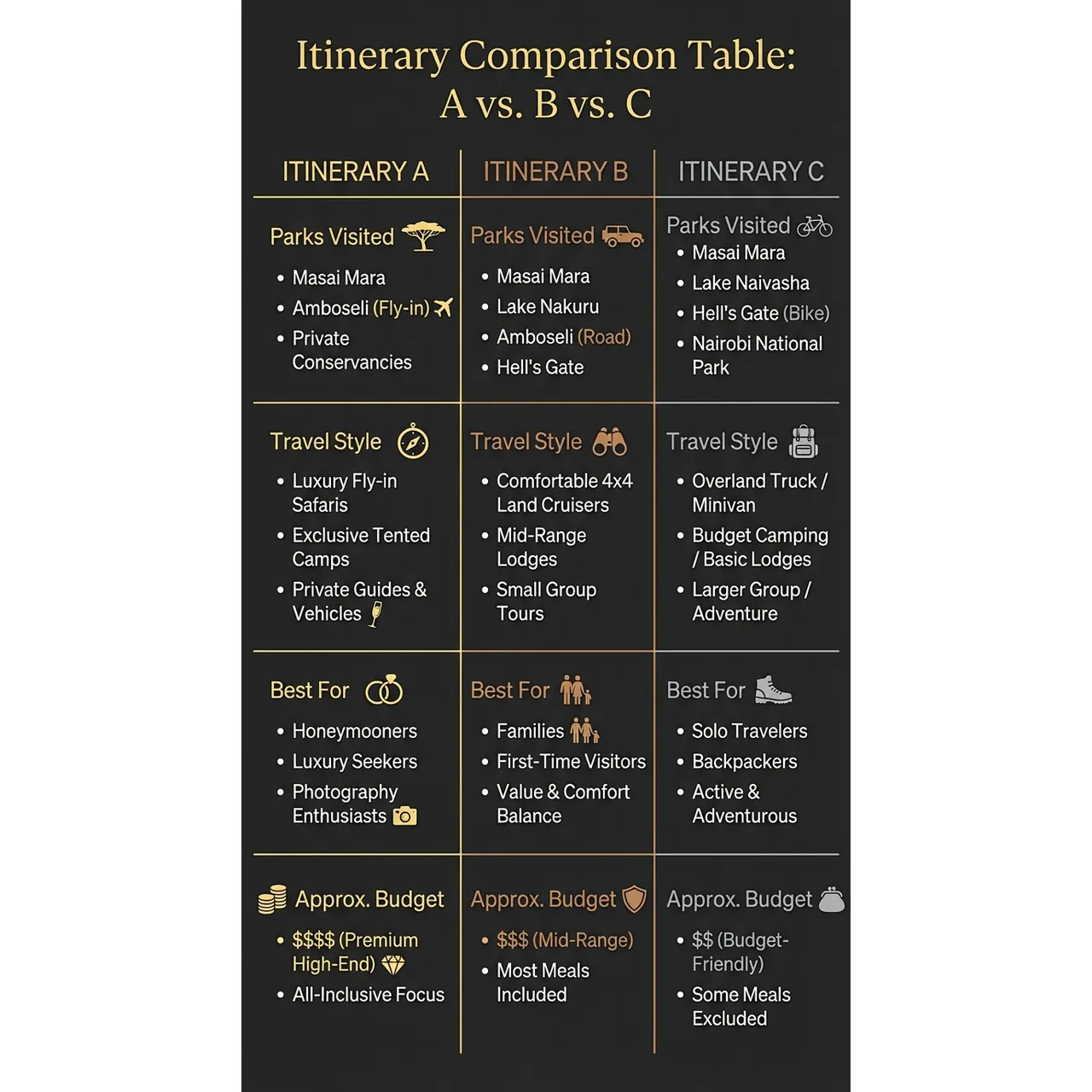
Below is a quick comparison of three proven Kenya 7 day safari routes that work well on the ground.
| Itinerary Name | Parks/Regions | Travel Style | Best For | Approx. Budget pp (sharing, excl. intl flights)* |
|---|---|---|---|---|
| A: Classic Big Cats & Big Views | Nairobi, Amboseli, Masai Mara | Mixed road/fly | First‑timers, couples, photographers | Mid: $3,800–$5,500 · Lux: $6,500–$9,500+ |
| B: Wildlife & Rhinos Sampler | Nairobi, Nakuru/Naivasha, Mara | Mostly road | Value‑seekers, rhino‑focused, families | Mid: $3,200–$4,500 · Lux: $5,500–$8,000+ |
| C: Migration‑Focused Mara Intensive | Nairobi, Masai Mara (+ conservancy) | Fly‑in or mixed | Migration chasers, photographers, repeat visitors | Mid: $4,000–$5,800 · Lux: $7,000–$10,000+ |
*These ranges move constantly. We can help pull realtime fresh quote for your dates.
Choosing between A, B, and C in one glance:
- If you want Kilimanjaro + elephants + Mara big cats, choose Itinerary A.
- If you want rhinos and variety on a mostly road‑based budget, choose Itinerary B.
- If you want maximum wildlife and photography time with minimal moving around, choose Itinerary C.
Side‑by‑Side Comparison of 7‑Day Kenya Routes
This comparison shows the usual 7‑day patterns people look at: Mara‑only vs Mara + Amboseli vs Mara + Nakuru/Naivasha vs Mara + Samburu.
| Route Pattern | Typical 7‑Day Structure (Nights) | Best For | Key Drives (hrs, one‑way) | Overall Fatigue Level* | Major Pros | Main Cons |
|---|---|---|---|---|---|---|
| Mara‑Heavy (Mara only) | 1N Nairobi, 5–6N Masai Mara | Photographers, migration chasers, repeat visitors | Nairobi → Mara: 5–6 hrs (road) or 45 min (flight) | Low–Medium | Maximum wildlife time, fewer pack‑up days, deeper sightings, strong use of a short trip | Less habitat variety, weak rhino options, no Kilimanjaro views |
| Mara + Amboseli | 1N Nairobi, 2N Amboseli, 3–4N Mara | First‑timers, couples, people who want textbook “Africa” shots | Nairobi → Amboseli: 4–5 hrs · Amboseli → Mara: 8–10+ hrs (road) or ~1.5 hrs (via Nairobi) | Medium–High (road only) · Medium (mixed) | Elephants, Kilimanjaro, and Mara predators in a single week | Very long Amboseli–Mara drive if done by road; flights push the budget up |
| Mara + Nakuru/Naivasha | 1N Nairobi, 1–2N Nakuru/Naivasha, 3–4N Mara | Value‑seekers, families, rhino‑focused | Nairobi → Nakuru: 3–3.5 hrs · Nakuru → Naivasha: 1.5–2 hrs · Naivasha → Mara: 5–6 hrs | Medium | Rhinos + boat safari + Mara, mostly paved roads, good cost‑to‑experience ratio | Slightly less Mara time than a pure Mara itinerary; more checking in and out |
| Mara + Samburu | 1N Nairobi, 2N Samburu, 3–4N Mara | Second‑timers, “northern specials” collectors | Nairobi → Samburu: 5–6 hrs · Samburu → Mara: 8–9+ hrs (by road via Nairobi or fly via NBO) | High (road only) · Medium–High (mixed) | Strong contrast between arid north and lush Mara, with species you will not see further south | Connection days are long, flights make it pricier, feels tight for genuine first‑timers in 7 days |
*Fatigue Level is based on active couples. If you already dislike longer drives at home, assume the higher number.
Rule of thumb for 7 days: aim for no more than two 5–6‑hour drives, and avoid any 8–10‑hour day unless there is a very good reason and you are fully aware of the trade‑off.
Itinerary A – Classic Big Cats & Big Views (Masai Mara + Amboseli)
Best for: First‑timers, couples, and photographers who want elephants, big cats, and Kilimanjaro in one Kenya 7 day safari plan and are ready to pay for at least one internal flight.
Ideal months:
- Jun–Oct: Migration in the Mara and dry conditions in both areas.
- Dec–Mar: Strong cat sightings and generally clearer skies for Amboseli.
Day‑by‑Day Breakdown
Day 1: Arrive in Nairobi
- Morning/afternoon: Land at Jomo Kenyatta International Airport (NBO).
- Transfer: Expect 30–60 minutes to most city hotels; if you land at rush hour, push that toward the upper end.
- Optional if your timing allows:
- Giraffe Centre (book a set time; it can get busy).
- Karen Blixen Museum.
- Short stop at good‑quality artisan shops in Karen, safer than random roadside curio stalls.
- Overnight:
- Mid‑range: Reliable Nairobi business or lifestyle hotel.
- Luxury: Smaller lodge in Karen or a top‑end city hotel with better food and security.
Day 2: Nairobi to Amboseli
- Travel:
- By road: 4–5 hours, almost all tarmac, but some potholes and slow trucks; fatigue: medium.
- By flight (Wilson Airport → Amboseli airstrip): ~40 minutes in a bush plane plus transfers; fatigue: low.
- Afternoon:
- Settle in, then head out on an afternoon game drive.
- Focus on elephants wading in the marshes, big buffalo herds, and lions if they are active. Clear‑sky days give you Kilimanjaro rising above everything; on hazy days, you will barely see the outline.
- Overnight: Lodge or tented camp inside the park or just beyond the gate. Camps right by the marshes are worth the small premium.
Day 3: Full Day in Amboseli
- Suggested rhythm:
- 06:00–09:30: Early morning game drive while Kilimanjaro is at its best and temperatures are cooler for both you and the wildlife.
- Late morning–early afternoon: Brunch, pool, nap, and time to sort and back up images.
- 16:00–18:30: Afternoon drive around the swamps where elephant herds, pelicans, and herons gather.
- Insider tips:
- In dry months, the dust is fine enough to get into everything. Keep a basic cloth over your camera and have a lens cloth ready.
- For most guests, a 70–200mm or 100–400mm lens covers 90 percent of your needs in Amboseli. Super‑telephotos are useful but not essential.
Day 4: Amboseli to Masai Mara
Flying this leg is strongly recommended unless your budget simply will not stretch.
- Typical route:
- Morning: Fly Amboseli → Wilson (Nairobi) → Masai Mara airstrip. Combined flight time sits around 1.5 hours, plus time on the ground between sectors.
- Mid‑day: Land in the Mara, drive through prime habitat to camp; it already counts as a game drive.
- Late afternoon: Short outing before sunset if you feel up to it.
- Road alternative:
- Driving this sector in one day runs 8–10+ hours with a chunk of rough road; fatigue: high.
- On a one‑week trip, you give up almost a full day of potential game drives to save money.
Day 5: Masai Mara – Big Cats Focus
You have two main patterns:
- Two standard drives: Out around first light, back for lunch and rest, then out again in late afternoon.
- One long day: Pack a picnic, stay out, and push deeper into the reserve or Triangle.
Expect:
- Strong lion sightings; often multiple prides.
- Cheetahs in the open grass if conditions are right.
- Leopards if you are patient and your guide reads tracks and bush signs well. No one can guarantee leopards, regardless of what the brochure says.
- Big mixed herds of wildebeest, zebra, and topi; hippos and crocs in the river pools.
Day 6: Masai Mara – Second Full Day
- Migration season (Jul–Oct):
- Spend more time near the Mara or Talek River systems.
- Understand reality: you might sit for hours watching herds build and still not see them jump. Or you might catch several crossings in a single morning.
- Non‑migration months:
- You get fewer vehicles at major sightings and calmer scenes with resident game.
- Optional add‑on:
- Hot‑air balloon safari with bush breakfast. Budget $450–$600 per person as a rough guideline. Confirm early; dawn balloon slots sell out months ahead in peak season.
Day 7: Masai Mara to Nairobi & Departure
- Early morning: Final game drive if your flight schedule allows it.
- Late morning/early afternoon:
- Fly Mara → Wilson (about 45 minutes).
- Connect by road to Jomo Kenyatta. Build in 1–1.5 hours for road transfer plus a serious traffic buffer.
- Timing tip:
- Keep a 3–4 hour buffer between your scheduled arrival at Wilson and your international check‑in time. If your outbound flight is very late at night, add a Nairobi hotel night instead of cutting things too fine.
Itinerary B – Wildlife & Rhinos Sampler (Masai Mara + Lake Nakuru/Naivasha)
Best for: People who want reliable rhino chances and a mix of game drives, a lake boat trip, and light walking on a mostly road‑based, cost‑sensible Kenya 7 day safari tour.
Regions: Nairobi, Lake Nakuru, Lake Naivasha, Masai Mara.
Day‑by‑Day Breakdown
Day 1: Nairobi Arrival
- Mirror Itinerary A: land, transfer, optional Giraffe Centre or museum stop if you are not half‑asleep.
- Overnight in Nairobi at a business hotel or small lodge.
Day 2: Nairobi to Lake Nakuru
- Drive: 3–3.5 hours with a stop at the Rift Valley viewpoint if the weather cooperates. Almost entirely paved; fatigue: low‑medium.
- Afternoon:
- Game drive inside Lake Nakuru National Park.
- Your focus: white and black rhinos, Rothschild giraffe, plus flamingos and other birdlife when water levels are right.
- Overnight: Lodge inside or overlooking the park. Staying close to the gate saves you time on the next morning’s drive.
Day 3: Lake Nakuru to Lake Naivasha
- Early morning: Short game drive in Nakuru if you still have not had a decent rhino or predator sighting.
- Drive: 1.5–2 hours to Naivasha, almost fully paved; fatigue: low.
- Afternoon:
- Boat safari on Lake Naivasha with hippos in the water and fish eagles grabbing fish off the surface at close range.
- Optional guided walk on Crescent Island or a similar private area, usually among zebra and antelope with no predators present.
Day 4: Naivasha to Masai Mara
- Drive: 5–6 hours, including a rougher stretch close to the Mara. Fatigue: medium‑high, particularly if the road is wet or heavily corrugated. Take water and a snack.
- Late afternoon: Short game drive in the Mara as you head to camp; you often see plenty before you even check in.
- Overnight: Tented camp or lodge either in the reserve or just outside a gate.
Days 5–6: Masai Mara – Two Full Days
- Structure:
- Standard morning and afternoon drives or one extended day out with a picnic.
- Focus remains on lions, cheetahs, and big mixed herds; from Jul–Oct you work around migration herd movements.
- If you are there in migration months, consider one river‑focused day and one day exploring a different section for variety.
Day 7: Masai Mara to Nairobi
- Option 1 (budget‑driven): Drive back to Nairobi in 5–6 hours and head to the airport or an overnight hotel.
- Option 2 (time‑driven): Take the 45‑minute flight to Wilson, then transfer to Jomo Kenyatta.
Pros, Cons & Who It’s For
Pros
- Very good rhino odds plus classic Mara game, with a boat trip in between to break up the vehicle time.
- Usually cheaper than combining Amboseli by air.
- Comfortable pattern for family friendly Kenya 7 day safari itineraries with shorter links between Nakuru and Naivasha.
Cons
- More total hours on tarmac than Itinerary C (Mara‑only with flights).
- Slightly fewer nights in the Mara compared with a pure Mara plan.
Choose this if:
- You want rhinos and variety on a realistic 7 day Kenya safari itinerary with drive times that stay within a mid‑level budget.
- You like the idea of mixing in walking and a lake day with standard game drives.
Itinerary C – Migration‑Focused Mara Intensive (7 Days Mostly in Masai Mara)
Best for: Serious wildlife enthusiasts, photographers, and repeat visitors who care more about hours with predators than ticking off different park names, especially in July–October migration season.
This is the foundation for the Photography‑Optimised 7 Day Kenya Safari later in this guide; the photography version is essentially a fine‑tuned Itinerary C with more detail around daily rhythm and guiding.
Day‑by‑Day Breakdown (Concise)
Day 1: Nairobi Arrival
- Same pattern as the other itineraries: arrival, short transfer, early night. Do not over‑plan this day if you have just come off an overnight flight.
Day 2: Fly to Masai Mara (First Area)
- Morning: Flight from Wilson to a Mara airstrip, around 45 minutes on a bush plane.
- Mid‑day: Check into a camp in the Masai Mara National Reserve or the Mara Triangle.
- Afternoon: Your first game drive, usually productive straight away.
Days 3–4: Masai Mara – Core Reserve
- Two full days based in a central zone:
- Ideal for large herds in Jul–Oct and resident big cats the rest of the year.
- You can choose between split drives or staying out all day if you have the stamina and the camp packs proper food.
Day 5: Move to a Conservancy (Optional Shift)
- Late morning: Switch from the main reserve to a private conservancy bordering the Mara, such as Olare, Naboisho, or Ol Kinyei.
- Afternoon: Game drive within the conservancy. Vehicle density drops sharply compared to some Mara hotspots.
Day 6: Conservancy Activities
- In many conservancies (subject to local rules), you gain access to:
- Night drives with a spotlight for hyena, civet, and other nocturnal species.
- Guided walks with an armed ranger.
- Off‑road driving in designated zones, crucial for low‑angle, close photographic work.
Day 7: Fly Back to Nairobi & Depart
- Fit in a short morning drive if your flight schedule allows.
- Late morning/early afternoon: Flight back to Wilson and onward road transfer to Jomo Kenyatta.
Conservancies vs Main Reserve – Key Trade‑Offs
You’ll see “conservancy” mentioned often. In the Mara context, private conservancies are community‑owned areas bordering the main reserve with controlled vehicle numbers and slightly different rules. In brief:
Main reserve / Mara Triangle
- Pros: Iconic river crossings, huge herds in season, classic wide‑open views.
- Cons: Can be busy at key sightings in peak months; off‑road driving and walks are more restricted.
Private conservancies
- Pros: Lower vehicle density, access to night drives, guided walks, and limited off‑road driving for better photographic positioning.
- Cons: Per‑night rates and conservation fees are typically higher; you may be farther from the main river crossing points.
A smart 7‑day plan like Itinerary C uses both: the main reserve or Triangle for drama and scale, plus a conservancy stay for exclusivity and flexibility.
Why Fewer Moves Can Mean More Sightings
Staying 5–6 nights in and around the Mara dramatically raises your odds of:
- Seeing an actual hunt unfold, not just hunting attempts. These often need multiple drives and a bit of luck.
- Photographing the same prides and coalitions in different light and behavior patterns.
- Avoiding the mental drag of constant packing and new‑camp briefings.
For photographers, this Kenya 7 day safari itinerary with maximum game viewing usually delivers more usable images than a “see everything” loop through three or four parks.
Cost Example for Itinerary C
When Is the Best Time for a 7 Day Kenya Safari?
Avoid the heavy rain months of Apr-Jun for maximum comfort.
Season & Month Overview
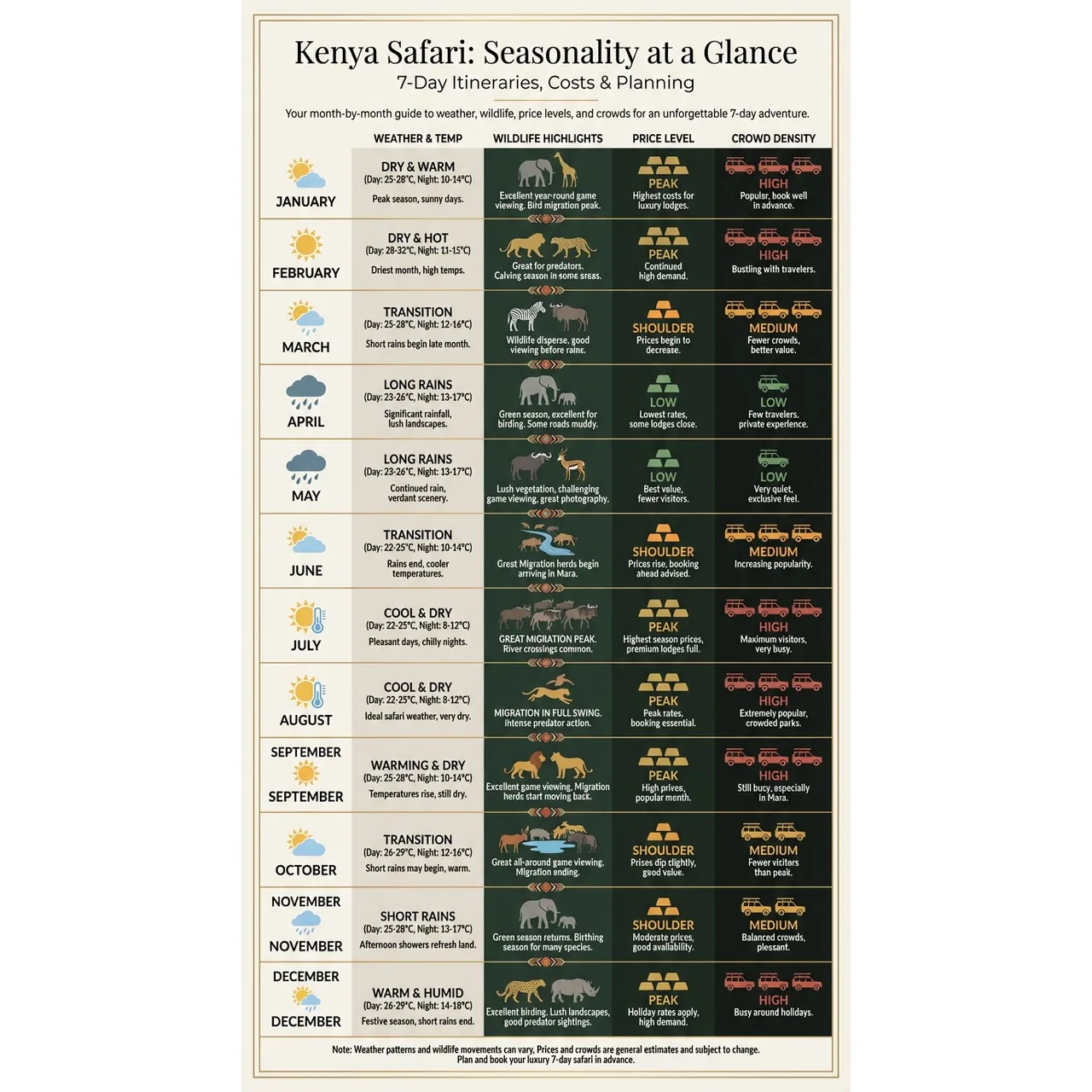
| Season / Months | Weather & Conditions | Wildlife Highlights | Pros | Cons | Price Trend |
|---|---|---|---|---|---|
| Jan–Mar | Warm to hot, generally dry, clear skies | Prime big‑cat action, plenty of general game, some calving | Fewer visitors than peak migration, great light | Midday heat, dust in some areas | Mid |
| Apr–Jun (esp. Apr–May) | Long rains; showers/storms, very green | Strong resident game, excellent birding | Lower prices, lush scenes, quiet camps | Some muddy roads; a handful of camps close | Low |
| Jul–Oct | Cool mornings, largely dry | Great Migration in Mara, huge herds, many predators | Iconic wildlife, high density | Highest prices, peak crowding in popular areas | High |
| Nov–Dec | Short rains; mix of sun and showers | Good resident game, newborns, migratory birds | Good value, lighter crowds than peak | Occasional intense storms; Kili can be hazy | Mid‑Low |
Best time for 7 day Kenya safari:
- Migration focus: late July–October.
- Big cats and clear skies without full peak crowds: January–March.
- Best value: November and parts of April–June, but check which camps are open and what roads look like.
Some guests combine Kenya and Tanzania for a cross‑border migration circuit, but that usually breathes properly only from 10+ days onward. With 7 days, you are generally better served committing to one country.
Practical Logistics for a Kenya 7 Day Safari
Road vs Fly‑In vs Mixed Safaris
Road‑only
- Pros: Lowest upfront cost, scenic views of local life between parks, flexible loading.
- Cons: Fatigue from long days, rough patches, and lost hours you could have spent with wildlife.
Fly‑in
- Pros: Quick, scenic, far less tiring, more time in the parks on a 7‑day schedule.
- Cons: Higher 7 day Kenya safari cost and strict luggage limits; you usually face soft‑bag caps around 15 kg including hand luggage. Check the airline’s current rules before you buy hard‑shell cases.
Mixed (the usual best option)
- Example: Drive Nairobi → Nakuru/Naivasha, fly Naivasha → Mara → Nairobi.
- Balance: Reduces the most demanding road days without turning the trip into a constant series of short flights.
Shared vehicles
- Lower cost and a sociable atmosphere.
- Fixed departure times and routes that balance different guests’ interests.
Private vehicles
- Full control over timing, pace, and focus (e.g., cats all day, or birding).
- Ideal for families (kids can nap, snack, or head back early) and photographers (you can stay with one sighting for hours if you wish).
For luxury and upper mid‑range guests, consider a private vehicle for at least part of the itinerary, especially in the Mara.
Camp & Lodge Styles
Your preferred aesthetic can influence route choice:
- Classic tented camps: Canvas, campfires, lanterns, and a strong sense of place. Common in the Mara and conservancies; pair beautifully with Itinerary C.
- Contemporary lodges: Solid walls, clean design, strong Wi‑Fi, often more facilities (pools, small gyms). You’ll see more of these around Nakuru/Naivasha and as Nairobi overnights.
- Ultra‑luxury camps: Fewer tents, high staff‑to‑guest ratios, fine dining, extensive wine lists, spa tents, and highly experienced guides. Often located in private conservancies or prime corners of the main reserves.
If you are drawn to a particular style, ask your planner which regions and conservancies offer the best matches.
Entry, Health & Safety Basics
- Entry & visas: Many nationalities use an e‑visa or electronic travel authorization system. Rules change; do not rely on old blog posts. Check the official Kenyan government site or your consulate before you pay deposits.
- Health: Yellow fever and malaria advice changes over time. Talk to a travel clinic 6–8 weeks before your trip, with your draft itinerary in hand.
- Safety on safari:
- Stay in the vehicle unless your guide tells you otherwise.
- Give elephants and big cats plenty of space, even if other vehicles edge closer.
- In Maasai or other local communities, dress modestly and always ask before raising a camera.
Travel Insurance & Medical Evacuation
For a high‑end safari, comprehensive travel insurance is non‑negotiable:
- Look for policies that cover:
- Emergency medical evacuation from remote airstrips to a major hospital.
- Trip cancellation and interruption, aligned with your camp and operator deposit/refund terms.
- Baggage and camera equipment, if you are travelling with high‑value gear.
Many luxury camps are in remote locations where evacuation requires charter flights and coordination; a robust policy means you do not have to make that decision based primarily on cost under pressure.
7‑Day Kenya with Kids: Family Considerations
A one‑week safari with children can be outstanding, provided you plan around their pace.
Ideal pattern:
- Keep it to 2 bases (e.g., Itinerary B: Nakuru/Naivasha + Mara, or Itinerary A with flights to reduce transfer time).
- Aim for 2–3 hour drives where possible, with no more than one 5–6‑hour sector in the entire week.
Minimum age realities:
- Many camps have minimum ages for game drives and for walking activities; check these early.
- Under‑7s often cope better with one long drive per day rather than two; consider skipping some afternoon drives.
What to look for in camps:
- Pools, lawns, or small play areas for downtime.
- Family tents or interconnecting rooms, so everyone sleeps properly.
- Guides and staff experienced with younger guests, ideally with simple bush‑craft or kids’ programs.
Sample family‑friendly structure (based on Itinerary B):
- 1N Nairobi (pool and early night)
- 1N Nakuru (gentle game drive, rhinos)
- 1N Naivasha (boat trip, safe walk)
- 3–4N Mara (some shorter drives, one full rest afternoon)
We tailor family itineraries based on the kids’ interest and ability. Let us know ages and special interest when building your trip.
Packing & Preparation Tips for a 7 Day Safari
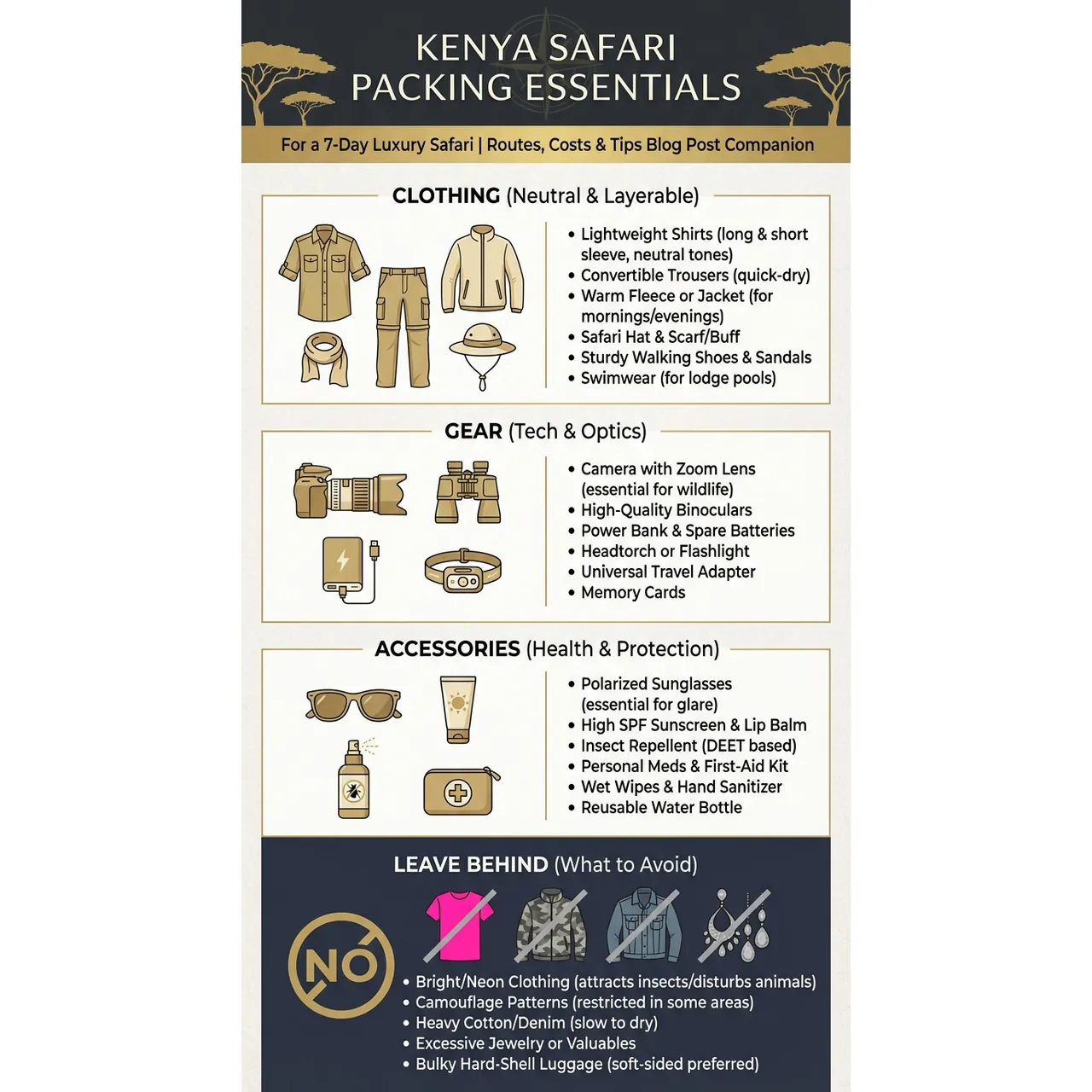
What to Pack (and What to Skip)
Essentials:
- Neutral‑toned clothing in layers. Mornings get cool, midday can be very hot in the sun.
- Light fleece or jacket, wide‑brim hat, sunglasses, strong sunscreen.
- Comfortable closed shoes or trainers. You do not need heavy boots for vehicle‑based safaris.
- One decent pair of binoculars per adult (8x or 10x). Sharing one pair among four people is not recommended.
- Camera with a 70–200mm or 100–400mm lens, spare cards, and extra batteries.
- Universal power adapter and a small power bank for phones and small devices.
- Soft‑sided duffel that respects typical light‑aircraft weight caps. If you insist on a hard suitcase for city time, leave it in Nairobi while you are in the bush.
Skip:
- Half your wardrobe. You will repeat outfits and nobody cares.
- Pure white or very dark clothing; both show dust and can be uncomfortable in the sun.
- Drones. Many parks and conservancies ban them outright, and fines are significant.
Beach & Safari Combos in 7 Days
Can I Fit Beach + Safari into 7 Days in Kenya?
You can, but you need to be realistic about compromises.
Most sensible pattern:
- 4–5 nights on safari (Mara + one other region)
- 2–3 nights at the coast (Diani, Watamu, or similar)
You will need:
- At least one domestic flight between the coast and your safari region.
- A willingness to trim Mara time or skip an add‑on park.
If wildlife is your main priority, dedicate the full 7 days to safari and add the beach before or after if you can stretch the trip.
If you can reach 9–10 nights, a more balanced, high‑end pairing might look like:
- 1N Nairobi · 5N Mara (split reserve + conservancy) · 3–4N Diani or Lamu, all fly‑in.
How to Plan Your 7 Day Kenya Safari (Step‑by‑Step)
- Lock your travel month based on migration, budget, and heat/rain tolerance.
- Pick your main focus: variety (Mara + Amboseli or Nakuru/Naivasha) vs deep dive (Mara‑intensive).
- Choose your budget band: budget, mid‑range, or luxury. Be honest with yourself; cutting corners halfway through the process wastes time.
- Decide travel style: road‑only, fly‑in, or mixed. For most one‑week trips, mixed wins.
- Shortlist 1–2 itineraries from this guide (A, B, or C plus any seasonal/photography tweaks) that match your profile.
- Contact Us to Find the Best Safari Operators: We have relationships with highly rated operators.
- Understand the fine print: park fees, flights, drinks, laundry, tipping expectations, vehicle type (shared vs private).
- Book international flights and insurance, once dates and deposits on the safari side are locked.
Frequently Asked Questions
How many parks in 7 days is too many?
For a realistic Kenya 7 day safari itinerary, 2–3 parks or regions is where things still feel like a holiday. Once you jump to 4 or more, you usually add:
- Extra packing and unpacking.
- More 5–7 hour drive days.
- Less time settling into each area and understanding its rhythms.
Aim for:
- Mara + 1 add‑on (Amboseli, Nakuru/Naivasha, or Samburu),
or - Mara‑only deep dive split between the main reserve and a conservancy.
Is it worth flying between parks on a 7 day safari?
On a one‑week itinerary, yes, in specific cases it absolutely is. Especially on:
- Amboseli ↔ Masai Mara
- Samburu ↔ Masai Mara
Flying:
- Saves you a solid full day in transit on some links.
- Cuts fatigue, which matters when you are already jet‑lagged.
- Lets you add a second top‑tier region without stripping too many game‑drive sessions off your schedule.
If your whole route sits within the Rift Valley and Mara (for example Nairobi–Nakuru–Naivasha–Mara), driving only is acceptable and usually better value.
Is 7 days enough to see the migration in Kenya?
Yes, if two things line up:
- You go between late July and October, and
- You spend at least 4–5 nights in the Masai Mara, ideally split across two zones.
That gives you:
- Multiple days to find large herds.
- A decent chance of key behavior: build‑ups at the river, crossings, predator action.
Nobody can promise you a crossing. A Mara‑intensive 7‑day plan just gives you the best odds a responsible operator can.
Is 7 days enough for a Kenya safari?
Yes. Seven days is enough to pair Nairobi with 2–3 serious parks such as the Masai Mara, Amboseli, and/or Lake Nakuru/Naivasha without turning the whole week into a line‑up of long transfer days, as long as you respect realistic drive times and do not chase every name on the map.
How much does a 7 day Kenya safari cost per person?
Most travelers fall roughly into:
- $2,000–$3,000 for budget,
- $3,000–$5,000 for mid‑range,
- $5,000–$10,000+ for luxury,
all per person for 7 days, excluding international flights. Season timing, flights, vehicle type, and camp level are the biggest levers.
Is it safe to self‑drive on a 7 day Kenya safari?
Technically yes. Practically, for first‑timers with one week, it is usually not the best use of your time.
A professional guide:
- Spots wildlife you would glide straight past.
- Handles park rules, paperwork, and ever‑changing road conditions.
- Lets you focus on the experience rather than dealing with maps, police checks, or surprise road closures.
Plan your Safari with Us
Let us help you plan the perfect Safari whether you want Kenya or Tanzania (or both).
Schedule your complimentary consultation below and let’s build your trip together.