Kenya vs Tanzania Safari How to Choose the Best Trip
Kenya vs Tanzania safari compared by cost, migration timing, routes, trip length, crowds, and wildlife so you can choose the right safari.
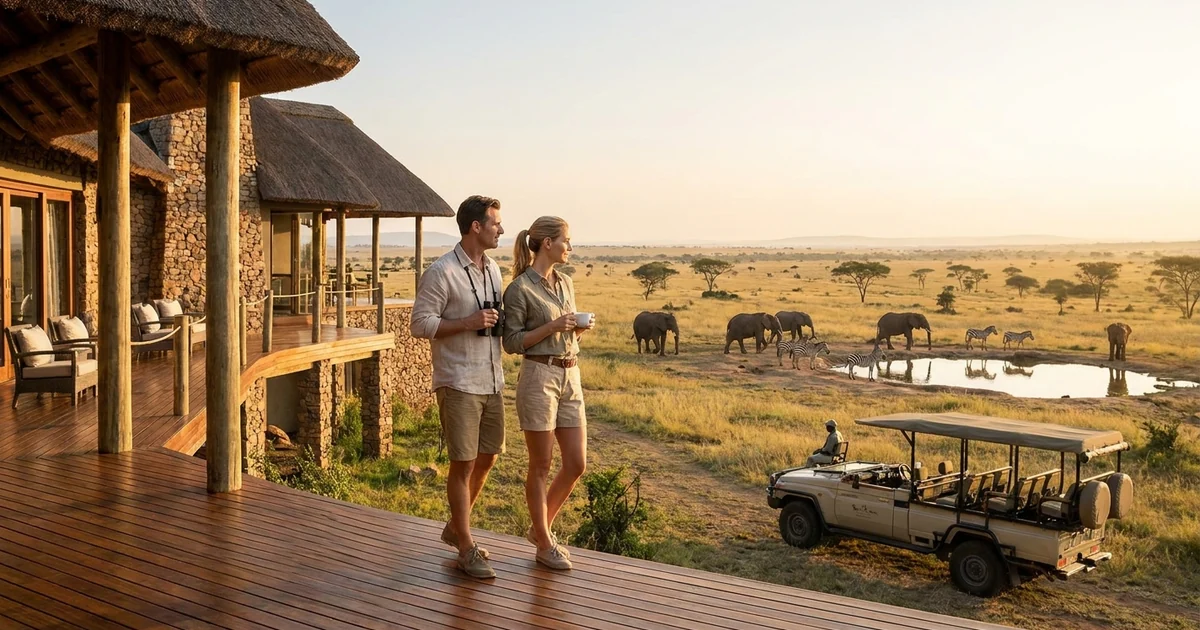
Choosing between a Kenya vs Tanzania safari is not about which country wins a popularity contest. It is about which one fits your month of travel, budget, trip length, and tolerance for long, dusty days in a vehicle.
I plan safaris year long, and I will walk you through a clear framework, cost ranges, and real‑world scenarios so you can pick a side without second‑guessing every choice. If you want to compare this choice with other regional options, you may also want to read guides that contrast Kenya vs South Africa safaris or broader breakdowns of the best African safari countries for first‑timers, then come back to this Kenya vs Tanzania deep dive.
Pricing and ranges in this guide are indicative for 2026-2027, but they are dynamic and we will recheck before we book you.
Quick Verdict by Traveler Type
| Traveler type | Better fit | Why |
|---|---|---|
| First safari under 10 days | Kenya | Easier flights, shorter transfers, strong wildlife density in the Masai Mara. |
| Migration calving season | Tanzania | Southern Serengeti is strongest from January to March. |
| Families with younger kids | Kenya | Shorter hops and easier beach add-ons reduce fatigue. |
| Photographers wanting huge landscapes | Tanzania | Serengeti and Ngorongoro offer scale, light, and dramatic open plains. |
| Luxury travelers wanting fewer vehicles | Either, with the right area | Choose Kenya conservancies or remote Tanzania sectors instead of only famous central parks. |
Quick Answer – Kenya vs Tanzania Safari in One Glance
If you are looking at a 7–10 days on safari with a mid‑range budget, Kenya usually gives better value, simpler logistics, and easier access to the Great Migration in July–October.
If you have 10–14 days, a stronger budget, and want big, open parks with fewer vehicles and more driving time between sightings, Tanzania usually comes out ahead.
At a Glance: Kenya vs Tanzania
| Aspect | Kenya | Tanzania | Best for |
|---|---|---|---|
| Wildlife density | Very high in Masai Mara; big cats often easy to find on a 3–4 night stay | Very high in Serengeti & Ngorongoro; game more spread across huge areas | Both: classic “BBC documentary” wildlife |
| Great Migration access | Peak Jul–Oct (Mara River crossings, short hops from Nairobi) | Herds present most of the year; Dec–Mar calving and Jun–Sep movements | Tanzania for calving, either for crossings |
| Crowd levels | Central Mara can be busy: 10–20+ vehicles at peak sightings | Central Serengeti can feel busy; remote sectors much quieter | Tanzania for “wilder” feel, Kenya conservancies for fewer vehicles |
| Typical cost range (pp/pn) | About US$350–$800 mid‑range; $800–$1,800+ luxury (land only, indicative) | About US$400–$900 mid‑range; $900–$2,000+ luxury (higher fees and distances) | Kenya for tighter budgets at mid‑range, Tanzania for premium wilderness |
| Ease of access & logistics | Nairobi hub; short flights to Mara; ideal for 7–9 day safaris | Kilimanjaro/Arusha or Dar; more time on roads or bush flights | Kenya for shorter trips or anxious travelers |
| Best for first‑timers | Very strong, especially 7–10 days with families or couples | Excellent if you have 10+ days and a solid budget | Kenya under 10 days; Tanzania for longer, “deeper” first safaris |
| Photographer Friendliness | Big cats + off‑road and night drives in conservancies | Wide horizons, quieter remote parks (Ruaha/Nyerere), calving season opportunities | Both – depends on month and style |
| Family Friendliness | Shorter transfers, more pools, child‑friendly lodges, easy beach add‑ons | Longer drives can wear out younger kids | Kenya, especially with under‑10s |
| Honeymoon Friendliness | Intimate conservancies, romantic camps, easy Mara + beach combos | Remote tented camps, huge skies, Serengeti + Zanzibar | Both – Tanzania for raw wilderness, Kenya for ease + private‑reserve feel |
| Wilderness feel | Strong, but some areas feel commercial | Very strong in large southern and western parks | Tanzania for sheer scale; Kenya conservancies for private‑reserve calm |
If you are sitting on 7–10 days and this is your first safari, Kenya normally causes fewer headaches and fewer hours on the road. If you want bigger horizons and more solitude, Tanzania is usually the heavier‑hitting option.
Start Here – 5 Questions to Decide Between Kenya and Tanzania
Start with these five questions. They settle most Kenya vs Tanzania debates before you even look at photos.
1. When Are You Traveling?
Your month determines where the herds are, how much rain you deal with, what you pay, and which country makes sense.
-
January–March
- Tanzania: Peak calving in the southern Serengeti. Wildebeest calves dropping everywhere, hyenas and lions working the edges. Dust, mud, big skies. Photographers love it.
- Kenya: The Masai Mara runs quieter but still delivers plenty of game. Rates often better than peak season.
- If you want wildebeest calves and predators working over them, Tanzania wins.
-
April–May (long rains)
- Both countries: Wet season. Roads are stickier, clouds heavier. Prices ease off. Some camps shut down.
- Wildlife is still there, but you must accept a higher chance of rain and some cancelled activities. Suits travelers who care more about budget and will definitely come back again.
-
June–October (prime dry season)
- Tanzania:
- Jun–Jul: Herds push north through central and western Serengeti.
- Jul–Sep: Northern Serengeti river crossings; cooler, drier air, strong general game.
- Kenya:
- Jul–Oct: Masai Mara hits its stride. Migration herds often cross into the Mara; dramatic river scenes.
- These months are superb in both countries, but they also carry the highest rates and the thickest vehicle traffic.
- Tanzania:
-
November–December (short rains)
- Tanzania: Herds drift back south through Serengeti.
- Kenya: Shoulder season; still solid game in the Mara, noticeably fewer vehicles than August, and better value.
Great Migration Safari Notes:
- The Great Migration spends most of the year in Tanzania, roughly 9–10 months in the Serengeti and 2–3 months in Kenya’s Masai Mara.
- “Seeing the Migration” is not one thing. You might be:
- Watching fixed herds stretched across the plains.
- Watching calving.
- Waiting for river crossings that may or may not happen while you are there.
Each plays out in different places, in different months.
2. What’s Your Budget (Per Person)?
A safari bill is driven by four main levers: park fees, camp category, flights vs long road slogs, and whether you insist on a private vehicle.
Indicative per person, per night (land only, no international flights):
-
Kenya – rough bands
- Group tours (simple lodges, full vehicles): ~US$250–$400 pp/pn
- Solid mid‑range private safaris: ~US$350–$800 pp/pn
- High‑end and top conservancies: ~US$800–$1,800+ pp/pn
-
Tanzania – rough bands
- Group tours: ~US$300–$450 pp/pn
- Mid‑range private: ~US$400–$900 pp/pn
- High‑end / luxury: ~US$900–$2,000+ pp/pn
Typical 7‑day ballparks (land only):
- 7 days mid‑range Kenya: ~US$3,000–$4,500 per person
- 7 days mid‑range Tanzania: ~US$3,500–$5,500 per person
Tanzania often runs about 10–20% higher for similar quality because:
- Park and concession fees are higher in headline areas.
- Distances between key parks are longer, so you pay in fuel or internal flights.
- There are fewer true budget beds in prime locations.
Consultant tip: Do not chase value by stringing together endless parks with 6–8‑hour road legs. You “save” on flights, then spend your best wildlife hours in transit. Better strategy: longer stays with fewer bases, and, if you can, one upgraded camp.
3. How Many Days Do You Have?
Your calendar length dictates what is realistic. This is where the Kenya vs Tanzania safari choice usually becomes obvious.
-
5–7 days on the ground
- I normally steer people to Kenya:
- You can hop from Nairobi to the Mara in roughly 40–60 minutes by air.
- You park yourself in one or two serious wildlife areas instead of watching tarmac and corrugations.
- You can make Tanzania work, but you either:
- Fly straight in and out of the Serengeti and forget the rest, or
- Burn big chunks of time on the classic Arusha–Ngorongoro–Serengeti road chain.
- I normally steer people to Kenya:
-
8–10 days
- Either country can be done properly:
- Kenya: Mara plus a contrasting region like Laikipia, Samburu, or Amboseli without racing.
- Tanzania: Northern Circuit (Tarangire + Ngorongoro + Serengeti) with 2–3 nights each, if you tolerate some road time.
- Either country can be done properly:
-
10–14+ days
- Tanzania starts to flex its muscles:
- You can do a full Northern Circuit and then push into Ruaha or Nyerere, or finish on Zanzibar without short‑changing the parks.
- At this length, we can stitch together Kenya + Tanzania combination safaris.
- Tanzania starts to flex its muscles:
4. Who Are You Traveling With?
Your travelling party matters as much as the map.
-
Families with young kids
- Kenya pros:
- Usually shorter transfers or quick bush flights between parks.
- Plenty of family‑friendly lodges with pools, family tents, and staff used to dealing with under‑10s.
- Straightforward beach bolt‑ons on the Kenyan coast (Diani, Watamu, Lamu).
- Tanzania cons:
- Northern Circuit drives of 4–6 hours on rough roads can be difficult for smaller kids.
- Strict park rules mean less freedom to get out, stretch, and explore.
- Kenya pros:
-
Couples / honeymooners
- Kenya: Private conservancies with low vehicle numbers, good guides, and camps built for romance. Easy to lace in a few lazy days by the Indian Ocean.
- Tanzania: More wilderness, less polished in places. Serengeti, Ruaha, and Nyerere have atmospheric tented camps where you fall asleep to lions grunting and not much else. Combine with Zanzibar for sand and water.
-
Photographers / serious wildlife nerds
- Kenya:
- Masai Mara and surrounding conservancies are a big‑cat sanctuary.
- Conservancies allow off‑road and night drives, which is a huge difference once you start thinking about about angles, backlight, and nocturnal behavior.
- Tanzania:
- Southern Serengeti calving (Jan–Mar) and Northern Serengeti (Jul–Sep) deliver heavy drama.
- Ruaha and Nyerere give you space, fewer vehicles, and often better natural behavior.
- Kenya:
5. Adventure vs Comfort Tradeoff
This is about your discomfort threshold.
-
Kenya
- Logistically kinder for first‑timers: Nairobi in, bush flight out, short drives.
- Good mix of tented camps and lodges that still feel like safari, not city hotels.
- Private conservancies let you walk, go out at night, and move off‑road, but in controlled, well‑run environments.
-
Tanzania
- Feels raw and further out in many areas, especially away from the Northern Circuit.
- Fewer night drives and stricter on‑road rules in national parks; you trade some flexibility for protection and scale.
- Circuits like Ruaha and Nyerere suit people who are comfortable with light‑aircraft flights, real darkness, and long days out.
If your priority is comfort, predictable transfers, and as little friction as possible, start your homework in Kenya. If the idea of emptier roads, bigger horizons, and some discomfort feels right, start mapping out Tanzania.
Value Per Day: 7, 9, and 12‑Day Kenya vs Tanzania Safaris
Headline prices are only useful if you know how many hours you spend actually looking at animals versus sitting in a vehicle going somewhere else.
Side‑by‑Side “Value per Day” Comparison
Indicative mid‑range, fly‑in or mixed fly/drive safaris in standard season, per person (land only):
| Length & Style | Country | Typical Price Band* | Internal Flights (legs) | Approx. Hours in Transit** (total) | Approx. Hours on Game Drives** (total) | Ideal Traveler Type |
|---|---|---|---|---|---|---|
| 7‑day core big‑cats safari | Kenya | US$3,000–$4,500 | 2–3 | 10–15 | 30–40 | First‑timer, couple or family wanting maximum wildlife in a short, efficient trip |
| Tanzania | US$3,500–$5,500 | 1–2 | 14–20 | 28–36 | First‑timer focused on Serengeti and ready for longer drives | |
| 9‑day classic circuit | Kenya | US$4,200–$6,500 | 3–4 | 14–20 | 40–55 | Guests wanting Mara plus a contrasting area (Laikipia/Amboseli/Samburu) |
| Tanzania | US$4,800–$7,200 | 1–3 | 18–26 | 38–52 | Travelers seeking Tarangire + Ngorongoro + Serengeti “grand tour” | |
| 12‑day in‑depth & varied safari | Kenya | US$6,500–$10,000+ | 4–5 | 18–26 | 55–75 | Honeymooners, photographers, or families wanting a slower pace + 3 regions |
| Tanzania | US$7,500–11,500+ | 3–5 | 22–32 | 55–75 | Serious safari‑goers wanting Northern Circuit plus remote south or beach add‑on |
*Approximate and always moving; verify for your dates.
**Transit = road transfers + flights + camp transfers. Game‑drive hours assume two solid activities per full day.
How to read this:
- With 7 days, Kenya usually gives you more time behind a camera or binoculars and fewer dead miles, for a bit less money.
- By 12 days, the game‑drive hours can look similar, but Tanzania expects more budget and more stamina to reach its real wilderness.
Kenya Safari Overview
Why Travelers Choose Kenya
- Masai Mara has big‑cat density. On a 3–4 night stay, you have a very high chance of lions and cheetahs, and a good crack at leopards.
- Private conservancies along the Mara border cap vehicle numbers, allow off‑road and night drives, and generally deliver calmer, more controlled sightings.
- Kenya has genuine choice: simple camps that still feel wild, solid mid‑range, and serious high‑end.
- Short flights out of Nairobi get you into wildlife quickly; perfect when you only have a week.
- Easy to add on Laikipia, Samburu, Amboseli, or the coast without creating routing chaos.
Drawbacks of Kenya to Consider
- Crowds in prime months: Central Masai Mara in August can feel congested when a cheetah jumps on a termite mound. 10–20 vehicles at one sighting is not rare.
- Some sectors feel very commercial if you choose badly: balloon after balloon in the sky, lodges stacked close.
- Compare Kenya’s standard circuit to Tanzania’s southern parks and Kenya feels smaller and more worked‑over.
How to handle the downsides:
- Base yourself in a private conservancy and use the Reserve sparingly.
- Target June, November, or early December for lower rates and fewer vehicles.
- If you can swing it, pay the premium for a private vehicle in peak months so you control the pacing, not the slowest person on a shared truck.
Key Parks in Kenya and What They’re Best For
- Masai Mara & Conservancies – Big cats, Migration (Jul–Oct), open grasslands, classic first‑safari territory.
- Amboseli – Elephant herds and, when the clouds cooperate, sharp views of Kilimanjaro; 2–3 nights is enough.
- Laikipia / Ol Pejeta – Rhino, walking, sometimes horse‑riding, strong conservation projects, and year‑round reliability. Great family and repeat‑visitor territory.
- Samburu – Hotter, semi‑arid, “northern specials” like Grevy’s zebra. Good if you dislike copy‑and‑paste landscapes.
- Tsavo East & West – Huge, less busy, best for guests who prefer wide spaces and fewer other vehicles even if sightings take longer to earn.
Tanzania Safari Overview
Why Travelers Choose Tanzania
- Huge, wild systems: Serengeti, Ruaha, and Nyerere feel like they keep going well past the horizon.
- The Great Migration is mostly on Tanzanian soil. If you care about Dec–Mar calving or Apr–Jun movements, you are in Tanzania, not Kenya.
- Ngorongoro Crater piles a staggering number of animals into a small bowl; you tick species fast, especially on a first trip.
- Beach extensions to Zanzibar put decent coral, history, and seasonal whale sharks into the same trip.
Drawbacks of Tanzania to Consider
- Longer road days: On the Northern Circuit, expect 3–6 hours between main stops on rough surfaces. If you hate being in a vehicle, you need to fly more or rethink.
- Higher fees and rates: Add up park fees, concession costs, and lodge pricing and Tanzania typically sits above equivalent Kenya trips.
- Stricter rules: In most national parks you stick to the roads and come back before dark. Photographers who are used to working off‑road and after sunset sometimes find this limiting.
Key Parks in Tanzania and What They’re Best For
- Serengeti National Park – The main stage for the Migration and predators.
- Southern Serengeti/Ndutu (Dec–Mar): Calving, muddy tracks, hyenas everywhere.
- Central/Western (Apr–Jun): Moving herds, strong game, looser crowds than the north in August.
- Northern (Jul–Sep): River crossings and steep banks; dramatic, but you often wait long hours.
- Ngorongoro Crater – Dense wildlife, including rhino, in a small area. One full day generally does the job.
- Tarangire – Elephants stacking along the river in the dry season (Jul–Oct), scattered baobabs, fewer people than Serengeti.
- Nyerere (Selous) & Ruaha – Southern circuit heavyweights: low visitor numbers, strong walking and boating where allowed, and camps that really feel cut off. Better for repeat or adventurous travelers.
Crowd & Photography Reality
Two lions and twenty vehicles do not feel wild. Vehicle pressure shapes the emotional tone of your safari more than most brochures admit.
This section brings together the crowd and photography guidance so you can judge where the experience will feel calm and where it may feel congested.
Numbers below are recent, rough patterns, not official caps.
Typical Vehicle Density by Area (Peak Season)
July–October tendencies:
| Area / Zone | Typical Vehicles at a Big Sighting | What It Means for Your Experience |
|---|---|---|
| Central Masai Mara National Reserve (Kenya) | 10–20+ | Busy, sometimes chaotic; engines, dust, and vehicles in your frame are common |
| Mara Conservancies (e.g., Olare, Naboisho) | 3–5 (often capped by policy) | Quieter; guides coordinate and sightings rotate to avoid pile‑ups |
| Eastern/Central Serengeti (Tanzania) | 5–15 | Can feel busy along main tracks; quieter once you push off the obvious loops |
| Northern Serengeti – main river areas | 5–15 at crossings | Pressure around narrow river points; calmer out on general game drives |
| Northern/Western “back roads” Serengeti | 1–6 | Often peaceful; time‑rich sightings and more natural behaviour |
What This Means for Photography and Animal Behaviour
- High density (10–20+)
- Animals often become edgy and move; guides feel pressure to rotate guests in and out.
- You fight dust, engine noise, and other vehicles in nearly every frame.
- Medium density (5–10)
- Doable with a good guide who positions early. You just need patience and longer lenses.
- Low density (1–5)
- Animals usually relax; you get longer, cleaner behavioural sequences.
- You can work with light, foregrounds, and compositions without constant repositioning.
When a Private Vehicle Is Worth Paying For
You should consider paying for a private vehicle if:
- You are a dedicated photographer and want control over when you wait and when you leave.
- You travel with young kids and your schedule must flex around naps, shorter attention spans, and early finishes.
- You are in prime months (Jul–Oct) in:
- Central Masai Mara, or
- Central or Northern Serengeti around the river belts.
In well‑run conservancies shared vehicles with only four to six guests and strong guides can still work extremely well without needing a private booking.
Logistics & Fatigue: Common Routing Patterns
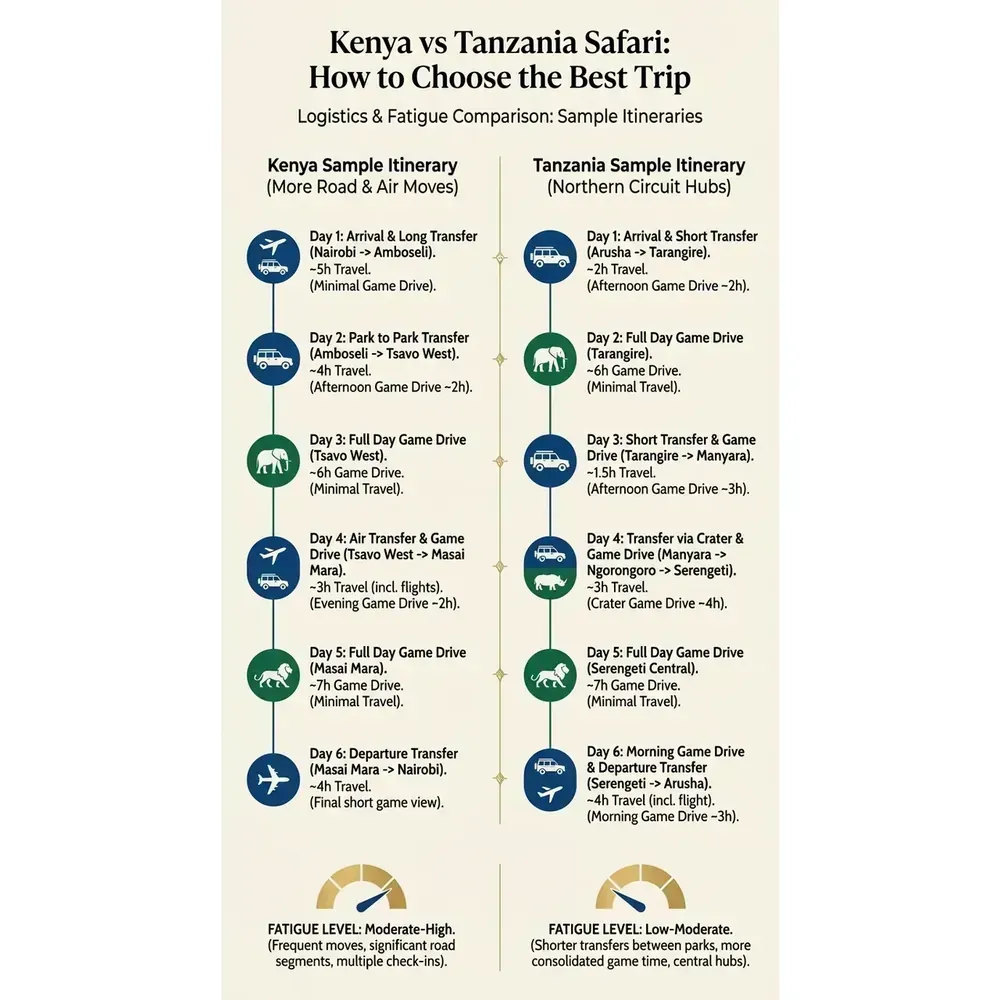
The elegance of your safari boils down to how many times you unpack, how long you sit on rough roads, and how much of your expensive week ends up spent in transit.
Kenya vs Tanzania Logistics & Fatigue Table
Indicative patterns for common mid‑range/private itineraries:
| Route Pattern | Country | Main Legs (typical) | Approx. Drive Times & Roads | Flights (if any) | Fatigue Level & Suitability |
|---|---|---|---|---|---|
| Nairobi – Mara – Nairobi (single‑area focus) | Kenya | Nairobi–Mara return | 5–6 hrs each way on mixed tar/gravel, or 40–60 min air | 0–2 bush flights | Simple, low complexity; very good for first‑timers & families |
| Nairobi – Mara – Laikipia – Nairobi | Kenya | Nairobi–Mara–Laikipia–Nairobi | Mainly short hops to bush strips | 3–4 short flights | Low fatigue if flown; strong for under‑10s and honeymooners |
| Nairobi – Amboseli – Mara – Nairobi | Kenya | Nairobi–Amboseli–Mara–Nairobi | 4–5 hr road to Amboseli if by car; flights ~30–45 min | 2–3 flights common | Moderate; fine if at least the Mara leg is flown |
| Arusha – Tarangire – Ngorongoro – Serengeti | Tanzania | Arusha–Tarangire–Ngorongoro–Serengeti–Arusha or Zanzibar | 2–3 hrs, then 3–4 hrs, then 4–6 hrs on rough roads | 1–2 flights often added | Medium–high fatigue; better for older kids, teens, and adults |
| Arusha – Ngorongoro – Central Serengeti only | Tanzania | Arusha–Ngorongoro–Serengeti–Arusha | 3–4 hrs + 4–6 hrs; bumpy in places | Often 1 flight out of Serengeti | Moderate; manageable over 8–10 days if the pace is not rushed |
| Fly‑in Serengeti + Zanzibar (no long road) | Tanzania | Arusha–Serengeti–Zanzibar–Arusha | Minimal road; mostly airstrips | 2–3 medium flights | Low–moderate fatigue; higher budget; honeymoon‑friendly |
| Dar – Nyerere – Ruaha – Zanzibar | Tanzania | Dar–Nyerere–Ruaha–Zanzibar–Dar | Very little road; mainly light aircraft | 3–4 light‑aircraft legs | Low road fatigue but remote feel; better for adventurous adults |
In practice:
- Kenya is built for shorter, cleaner fly‑in circuits. You get a lot of safari for relatively few hard miles.
- Tanzania’s Northern Circuit is iconic, but you must either tolerate longer road legs or pay for internal flights.
Kenya vs Tanzania for Different Traveler Types
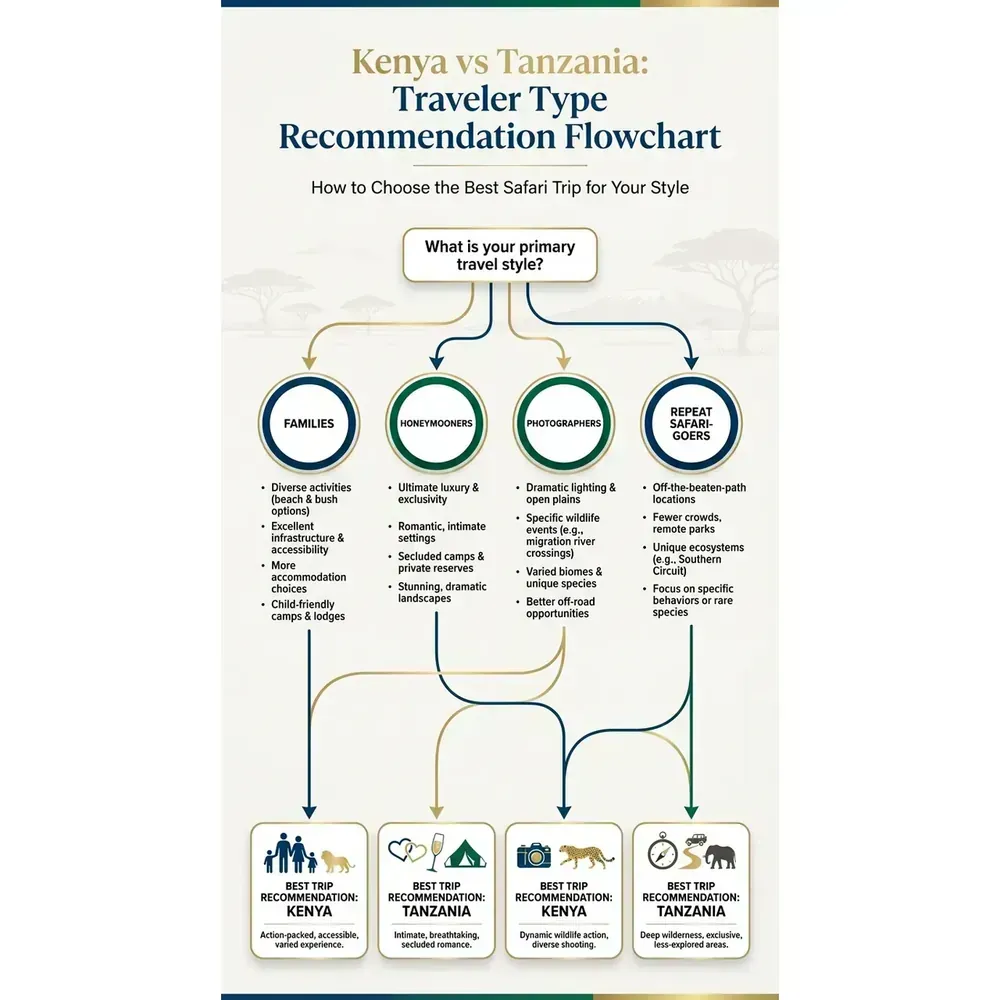
Kenya vs Tanzania for Families
-
Kenya – usually the stronger option
- Easy to design two‑stop itineraries of 3–4 nights each.
- Plenty of:
- Family tents and interleading rooms
- Pools and lawns for off‑jeep time
- Flexible food schedules
- Conservancies and Laikipia add:
- Gentle bush walks for older kids
- Cultural visits to Maasai or Samburu homes
- Horse or camel options in some properties
-
Tanzania – better once kids are older
- Long drives can turn into rolling geography lessons for teens, but young children often just get worn down.
- Strict park rules mean less freedom to hop out and explore.
- Zanzibar works very well with teenagers for watersports, history, and food.
Kenya vs Tanzania for Honeymooners
-
Kenya
- Small, design‑forward camps in Mara conservancies and Laikipia.
- Possibilities for sleep‑outs and star beds, private dinners, and surprise bush breakfasts.
- Smooth Mara + coast combinations without a maze of regional flights.
- Activities: night drives, walks, balloons, put together into a flexible schedule.
-
Tanzania
- Deeper isolation once you get into the Serengeti or the south.
- Mobile and semi‑permanent camps that feel raw but still comfortable.
- Beach:
- Zanzibar for classic white sand and rooftop bars.
- Mafia or Pemba for quiet beaches, heavier diving and snorkeling focus.
- Activities: boating in Nyerere, walks in select concessions, and cultural days with local communities.
Honeymoon verdict:
If you want simple routing, polished service, and lots of flexibility, pick Kenya. If you want a bigger sense of crossing into proper wilderness, lean Tanzania.
Kenya vs Tanzania for Photographers
-
Kenya strengths
- Mara conservancies allow:
- Off‑road access to get low angles and use side light properly.
- Night drives for nocturnal behaviour and big cats after sunset.
- High predator density means second chances when you mess up a shot.
- Mara conservancies allow:
-
Tanzania strengths
- Calving (Jan–Mar) in Southern Serengeti/Ndutu gives volume: calves, chases, kills, storms.
- Northern Serengeti (Jul–Sep) usually has fewer vehicles than central Mara around crossings.
- Ruaha and Nyerere let you work with more natural behaviour and less pressure from other trucks.
Rule of thumb:
- Want off‑road, night, and heavy big‑cat work in a short time window? Go Kenya conservancies.
- Want Migration drama, calving, and huge skies with fewer trucks in the frame? Build around Tanzania, and give it at least 10 days.
Kenya vs Tanzania for Repeat Safari‑Goers
-
Kenya for follow‑up trips
- Go deeper in:
- Laikipia for walking, rhino tracking, and conservation immersion.
- Samburu and the north for new species and harsher beauty.
- Combine Mara with more obscure conservancies to cut the crowds.
- Go deeper in:
-
Tanzania for follow‑up trips
- Push out to Ruaha, Nyerere, Mahale, or Katavi:
- Very low densities of other guests.
- Walking, boating, and in Mahale, chimp trekking.
- Revisit the Serengeti in a different section and season for a completely different feel.
- Push out to Ruaha, Nyerere, Mahale, or Katavi:
If you have already done Mara/Laikipia, looking at Serengeti or the southern parks in Tanzania is usually the next logical move.
Safety, Health, and Practicalities
- Overall safety: Properly arranged safaris in both countries are highly controlled environments. Camp rules keep you out of trouble; problems usually arise in cities or from ignoring guidelines, not in the bush.
- Health: Much of both countries lies in malaria zones. Prophylaxis, vaccines, and personal protection are not optional. Get specific, current advice from a travel doctor long before your departure.
- Visas:
- Many travellers use e‑visas or visas on arrival for Kenya and Tanzania, but regulations change. Always check the official government sites, not hearsay on forums.
- Paperwork traps: Both countries occasionally adjust entry rules, electronic permits, or park fee structures with minimal notice. Do not leave visa checks, yellow‑fever documentation, or insurance proof until the last week.
Use licensed operators and properly maintained vehicles. The cheapest quote often saves money by cutting corners on these exact items.
Ethical and Sustainability Considerations
Conservancies vs National Parks
- Kenya
- The conservancies around the Mara and in Laikipia use a land‑lease model with local Maasai communities.
- This usually means lower vehicle density, capped bed numbers, and more direct community income.
- Tanzania
- Focused heavily on large, national‑park estates. Protection is strong, but benefits to local communities depend on more complex fee and concession structures.
- Private concessions exist but are not yet as widespread as Kenya’s conservancy model.
If community ownership and lower guest density matter to you, prioritise a Kenyan conservancy‑led itinerary.
Animal Welfare and Responsible Guiding
Whichever country you pick:
- Ask operators how many vehicles they allow at a sighting and how they control behaviour.
- Favour guides and companies that back off when animals are stressed, rather than edging closer for a better tip.
- Ethical guiding leads to calmer wildlife and better photographs, not just better karma.
How to Choose Low‑Impact, High‑Benefit Operators
To tilt your spend toward positive impact, consider:
-
Community benefit
- “How do local communities earn from this camp beyond wages?”
- “Roughly what percentage of my stay goes to land leases or community projects?”
-
Conservation model
- “How are animal‑viewing rules enforced in busy sightings?”
- “Do you limit vehicle numbers at key sightings or rotate vehicles?”
-
Environmental footprint
- “How do you manage water, energy, and waste in camp?”
- “What happens to plastic waste and grey water?”
Genuinely responsible operators will answer these questions specifically and confidently. If you get vague generalities, treat that as a warning sign.
FAQs – Quick Answers to Common “Kenya vs Tanzania” Questions
Is Kenya or Tanzania better for a first safari?
Under 10 days, usually Kenya. You get high impact with simpler routing. With 10–14 days and a more generous budget, Tanzania’s Northern Circuit is an excellent first safari too, but you must accept longer road legs or higher flight costs.
Which is cheaper: Kenya or Tanzania for safari?
Typically Kenya, especially in the mid‑range. Tanzania’s higher park fees, larger distances, and fewer entry‑level camps at prime locations often push costs 10–20% above similar Kenyan itineraries.
Where is the Great Migration: Kenya or Tanzania?
The herds are mainly in Tanzania’s Serengeti for roughly 9–10 months each year. They cross into Kenya’s Masai Mara mainly from about July to October. Tanzania is key for Dec–Mar calving, and both countries offer river crossings July–September, but on different stretches and with different crowd levels.
Is Kenya or Tanzania better for families with kids?
For younger children, Kenya is usually better: shorter transfers, more family‑oriented lodges, and easier logistics. Tanzania can be excellent for older kids and teens who can handle long drives and stricter park rules.
Kenya vs Tanzania for honeymoon – which is more romantic?
Both can be very strong. Kenya tends to win on ease and polished service with simple coast add‑ons. Tanzania wins on sheer wilderness: big skies, fewer people, and long views.
Can I see the Big Five in both Kenya and Tanzania?
Yes. Both countries can give you the Big Five on a well‑designed 7–10 day itinerary. Rhinos require specific stops: think Ol Pejeta or certain Mara / Laikipia areas in Kenya, and Ngorongoro Crater or select Serengeti sectors in Tanzania.
Is it safe to do a safari in Kenya or Tanzania?
Well‑run safaris in both countries are very safe. Camps operate strict safety protocols; major risks usually relate to city crime, medical issues, or road incidents. Stick with licensed operators, follow camp rules, and consult a travel clinic for vaccinations and malaria prophylaxis.
Plan your Safari with Us
Let us help you plan the perfect Safari whether you want Kenya or Tanzania (or both).
Schedule your complimentary consultation below and let’s build your trip together.