Amboseli vs Maasai Mara - How to Choose Your Safari
Amboseli vs Maasai Mara - compare wildlife, seasons, costs and travel style. Decide if you should pick one or combine both in a smart Kenya safari.
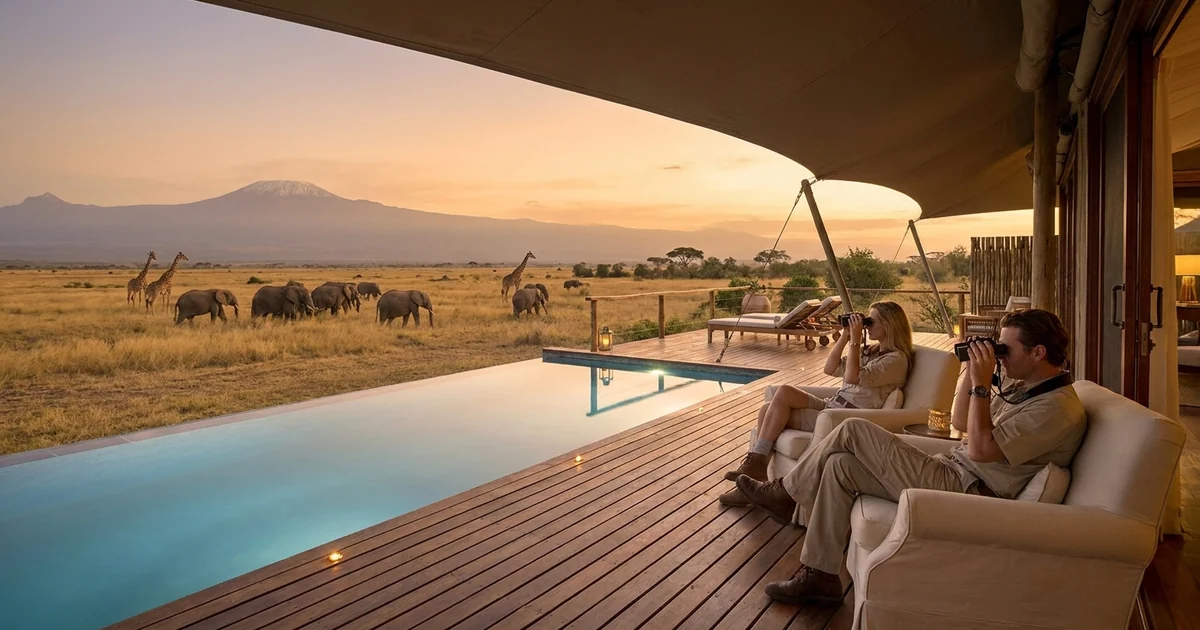
Amboseli vs Maasai Mara is one of the key decisions in any Kenya safari plan. Both deliver serious wildlife, but in very different ways. Maasai Mara wins on big cats, wildlife density, and the Great Migration. Amboseli is the place for huge elephant herds and that classic Mount Kilimanjaro backdrop. Below I’ll help you decide, based on your dates, budget, and how you actually like to travel, whether you should pick Amboseli, Maasai Mara, or a tight, efficient combo.
If you only skim one section, read “How to Decide in 5 Steps” near the end. It distils the whole article into a short decision workflow.
Quick Answer: Should You Choose Amboseli or Maasai Mara?
TL;DR Comparison in One Glance
If you are 2–6 months from travel and wrestling with Amboseli or Maasai Mara, use this rule of thumb: choose the Mara for maximum wildlife density and big cats, Amboseli for elephants and stark landscapes, both if you have 6–10 days and a healthy budget.
If you are considering a “healthy budget”, plan in the region of US$1,000–1,800+ per person per night in high season for top conservancies and premium camps, excluding international flights.
Amboseli vs Maasai Mara – Key Comparison
| Factor | Amboseli National Park | Maasai Mara (Reserve & Conservancies) |
|---|---|---|
| Signature experience | Large elephant herds with Mt Kilimanjaro in the background; compact, high‑impact viewing | Big cats + very high wildlife density; Great Migration (roughly Jul–Oct) |
| Wildlife density & variety | Good overall; outstanding elephants, good general game, fewer big cats | Excellent; lions, leopards, cheetahs, abundant plains game, some rhino in specific areas |
| Landscape & photography | Flat saline pans, marshes, dust, and Kilimanjaro; strong minimalist frames | Rolling savannah, scattered acacias, rivers, stormy skies, migration crossings |
| Best months overall | Typically Jun–Oct, Jan–Feb; shoulder seasons can be strong with fewer people | Typically Jun–Oct (dry + migration), Jan–Mar; Apr–May & Nov–Dec are lush, quieter, often better value |
| Typical stay length | 2–3 nights | 3–5 nights (longer if using multiple conservancies) |
| Distance from Nairobi | ~4–5 hrs by road; 40–50 min flight | ~5–6 hrs by road (varies by gate); 45–60 min flight |
| Crowd level | Moderate; generally calmer than the Mara in peak | High in main reserve in Jul–Oct; lower in conservancies year‑round |
| Ideal for | Short trips from Nairobi, elephant addicts, landscape shooters, those who want a slightly quieter pace | First‑time safaris, big‑cat fans, migration hunters, families & honeymooners who want “documentary” wildlife |
| Typical mid‑range cost (pppn) | Approx US$350–650 sharing | Approx US$400–900 sharing (conservancies hit the higher end, especially in migration season) |
(pppn = per person per night, excluding international flights; all costs are indicative and move constantly with season, fuel, and park fees. Always check live rates for your dates.)
Traveler‑Type Snapshot: Who Should Choose Which Park?
Use this as a quick “people like me” filter to narrow down the list.
Amboseli vs Maasai Mara by Traveler Type (What I’d Recommend and Why)
| Traveler Type | Best Choice | Why This Park Fits You |
|---|---|---|
| Serious photographer | Combo (Amboseli + Mara) | Amboseli gives elephants + Kilimanjaro, dust, stripped‑back frames. Mara gives big‑cat behaviour, herd patterns, and moody skies. Together you walk away with a genuinely rounded portfolio. |
| Casual photographer / Instagram‑focused | Mara (conservancy if possible) | Very high “wow per drive”: lions on mounds, herds to the horizon, silhouettes under acacias. Fewer vehicles in conservancies means clean backgrounds and less chaos. |
| Family with young kids (under ~8) | Amboseli (3 nights) | Shorter journey from Nairobi, small park, elephants spotted fast, and you avoid marathon game drives. Less chance of overtired, car‑sick kids by day two. |
| Family with older kids/teens | Mara (3–5 nights) | Non‑stop variety keeps attention spans from crashing. Many camps have pools and big family tents. Teens who’ve watched nature shows finally see those lions and cheetahs in real life. |
| Honeymoon / romantic trip | Combo, weighted to Mara conservancy | Amboseli for quiet Kilimanjaro dawns and big elephant families. Then 3–4 nights in a Mara conservancy for top‑end tents, cats, and private bush dinners away from the crowds. |
| Budget traveler with 3–4 days | Amboseli only | Lower all‑in costs with road transfers, great elephant viewing even from simpler lodges, and no pressure to pay migration premiums. You keep more of your budget for future trips. |
| Budget traveler with 5–7 days | Mara only (shoulder season) | In off‑peak months you can stretch 4–5 nights at a decent Mara camp and maximise “wildlife per dollar” instead of paying top money for two parks. |
| Big‑cat obsessive | Mara (reserve +/or conservancy) | The density of lions, cheetahs, and leopards here leaves Amboseli behind. With a solid guide and 3+ nights, you usually stack multiple cat sightings. |
| Elephant/landscape lover | Amboseli (2–3 nights) | Big, often relaxed elephant herds wandering across a stark basin with Kilimanjaro when the sky opens. Nearly every drive tilts toward your favourite animal. |
| Once‑in‑a‑lifetime, milestone safari (8–10 days) | Combo (3–4 nights Amboseli + 4–6 nights Mara) | You have the time and budget. Use both parks for real contrast in scenery and wildlife, and the trip starts to feel like a curated, multi‑chapter story rather than a sampler. |
When Amboseli Is the Better Choice
In one line: choose Amboseli when elephants, Kilimanjaro, and a calmer atmosphere matter more than wall‑to‑wall predators.
Pick Amboseli if:
- You have 2–3 days total from Nairobi and do not want half of that lost to long transfers.
- Elephants and strong landscapes matter more to you than seeing three different big cats every day.
- You dislike crowded sightings and the crowd that can appear around famous Mara lions.
- You already have the Serengeti in your route for migration and predators, so you do not need two similar big‑cat arenas.
- You are a photographer who wants:
- Elephant herds at first light with Kilimanjaro behind them.
- Backlit dust, silhouettes, and mirrored bodies in the marshes.
- You are travelling in green season (Apr–May, Nov) and don’t want to fight with long grass. Amboseli’s open plains and marsh edges still give you surprisingly good visibility when the Mara turns into a lion‑sized hayfield.
With three nights in Kenya and a mid‑range budget, I often steer people to Amboseli only. You sacrifice the Migration, but you protect your time and avoid burning a large portion of a short trip in transit.
When Maasai Mara Is the Better Choice
In one line: choose the Mara when you want maximum “National Geographic” intensity—big cats, variety, and, in season, the Migration.
Choose Maasai Mara if:
- This is your first or only safari and you want heavy wildlife action without subtlety.
- Big cats top your wish list and you don’t want to rely on luck.
- You are trying to intersect the Great Migration in Kenya (roughly late July–October.
- You can sink 3–5+ nights into one region and want layered, varied game viewing.
- You are travelling with children or a partner who has the classic picture of golden grass and animals everywhere stuck in their head.
Concerned about crowds? Focus on Mara conservancies rather than focusing only in the main reserve. Conservancies usually cap the number of vehicles, allow some off‑road driving, and manage sightings better. Rules are not identical across all conservancies and they change. Ask us to confirm current policies—and to explain how those rules improve your actual viewing experience—before you pay deposits.
When It’s Worth Doing Both
In one line: combine Amboseli and the Mara when you have 6–10 days in the bush and a budget that supports internal flights and quality camps.
Combine Amboseli and Maasai Mara when:
- You have 6–10 days in Kenya in the bush, not counting Nairobi.
- This is a honeymoon or major milestone safari and you want variety rather than a simple “big cat binge.”
- You are a photographer building a serious portfolio: elephants plus Kilimanjaro, then predators, herds, maybe migration drama.
Sample 7‑Day Combo Outline
- Day 1: Arrive Nairobi → fly or drive to Amboseli, afternoon game drive.
- Days 2–3: Amboseli game drives (elephants, low‑angle marsh work, Kilimanjaro when it shows).
- Day 4: Morning drive, then fly Amboseli → Nairobi → Maasai Mara.
- Days 5–6: Maasai Mara (reserve or conservancy) for big cats and heavy general game.
- Day 7: Final Mara drive → fly back to Nairobi.
For a mid‑range couple, this 7‑day Amboseli vs Maasai Mara itinerary usually falls around US$4,500–6,500 per person (sharing, excluding international flights) at recent levels. Treat it as a ballpark. Safaris are price‑sensitive to season, park fee changes, and exchange rates. Always get fresh quotes for your exact dates.
Amboseli vs Maasai Mara: Side‑by‑Side Comparison
Location, Size, and Scenery
Amboseli National Park
- Location: Southern Kenya near the Tanzania border, under Mount Kilimanjaro.
- Size: Compact core park (about 392 km²), surrounded by Maasai community lands.
- Scenery: Broad, flat pans, shallow seasonal lakes, permanent marshes fed by Kilimanjaro’s underground springs, frequent dust devils in dry months.
You get a stripped‑down visual style: elephant lines crossing pale, cracked ground; single acacias under a huge sky; long views with almost no visual clutter. The catch is late dry season. Conditions turn very dusty and hazy, which plays havoc with lungs, camera sensors, and contact lenses if you are not prepared.
Maasai Mara
- Location: South‑west Kenya, sharing an open border with Tanzania’s Serengeti as one shared ecosystem.
- Size: Maasai Mara National Reserve covers about 1,510 km². Surrounding private conservancies add a large additional buffer of protected land.
- Scenery: Undulating savannah, scattered acacias, the Mara and Talek rivers, rocky outcrops, and the Oloololo Escarpment.
You have more varied backdrops and shooting angles: cheetahs on termite mounds, lions under isolated trees, herds on riverbanks, storm fronts rolling over yellow grass. That same variety means grass can grow tall in the wet months and hide animals if your guide isn’t sharp.
Consultant note: If your top priority is diverse scenery and the archetypal savannah feel, Maasai Mara takes the edge. If you want clean, graphic frames with a small number of subjects in a big open space, Amboseli is your playground.
Wildlife: What You’re Likely to See (and How Often)
On a 3‑night stay, here is what you can expect:
- In Maasai Mara, most guests see lions multiple times, often cheetahs, and regularly leopards in the right areas with decent guides. Plains game is almost constant.
- In Amboseli, you almost trip over elephants on every drive, often at close range, plus buffalo, giraffe, zebra, wildebeest, and good birdlife. Big cats exist but they are not on a predictable timetable.
Wildlife Spotting Probabilities (2–3 Night Stay)
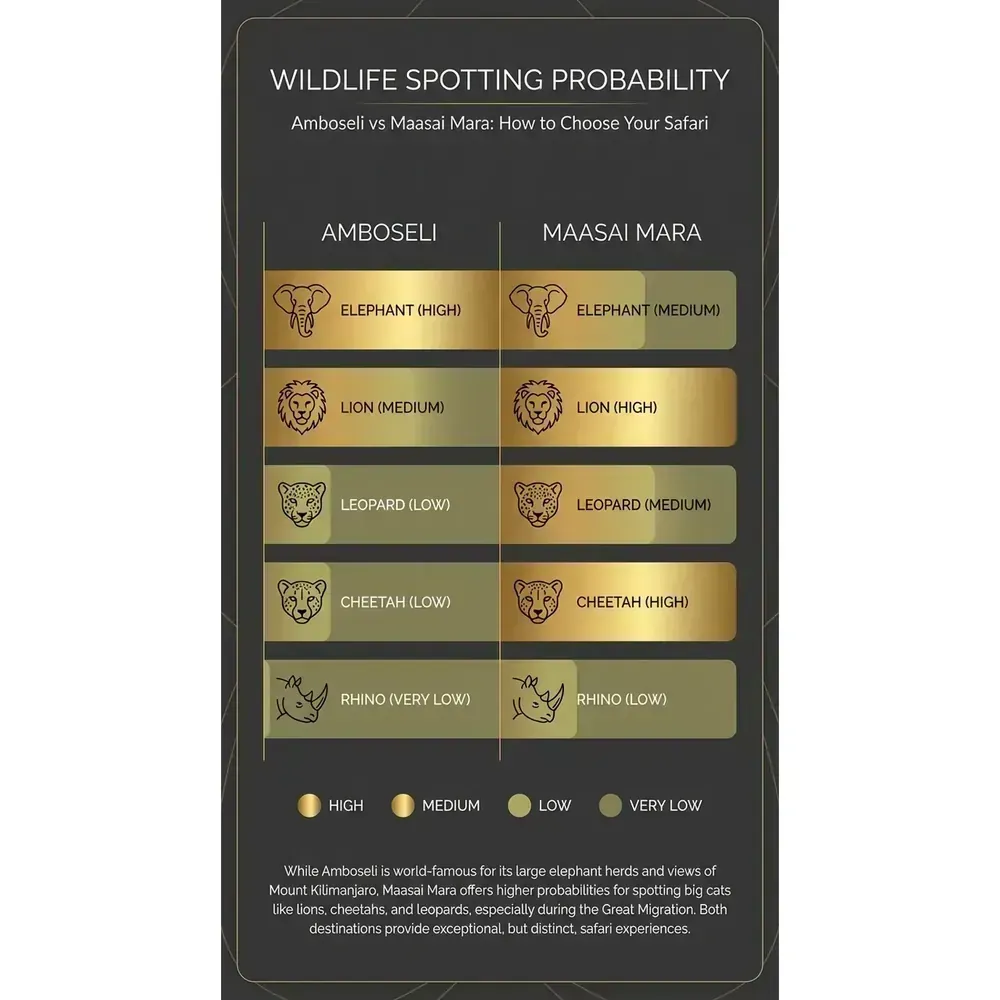
| Species / Category | Amboseli | Maasai Mara (Reserve/Conservancies) |
|---|---|---|
| Elephants | Excellent – multiple herds daily, chance of very large tuskers | Good – regular sightings but not as concentrated as Amboseli |
| Lions | Decent but not on every drive | Excellent – high chance every day, often several prides |
| Leopards | Patchy – you might get one, you might not | Good–Excellent – regular in many zones with capable guides |
| Cheetahs | Patchy – some residents but sightings are not frequent | Excellent – open plains suit them; regular encounters |
| Rhino | Unlikely | Patchy – limited to particular zones and conservancies; not a sure thing |
| Giraffe, zebra, wildebeest, buffalo | Good to Excellent | Excellent |
| Birdlife | Strong around marshes and water | Excellent – multiple habitats, lots of raptors and waterbirds |
| Overall Big Five probability (3 nights) | Possible but unreliable | High chance of 4–5/5 with time and a good guide |
What a Typical 2–3 Night Stay Delivers
-
Amboseli (2–3 nights):
- Several close elephant encounters, usually every drive.
- Frequent zebra, wildebeest, buffalo, giraffe, hippos in marshes, and mixed antelope.
- Depending on weather, grass, and luck: hyena, jackal, occasional lion or cheetah.
- Solid birding around the swamps and lakes.
-
Maasai Mara (2–3 nights):
- Lions almost daily, hyenas and jackals very likely.
- Good chances of cheetahs; reasonable odds of leopard if your guide understands territories.
- Heavy mixed herds of plains game, plus hippos and crocodiles along rivers.
- From roughly Jul–Oct, a real chance of migration herds somewhere in the ecosystem, but where and how many changes year by year.
Best Time to Visit Amboseli vs Maasai Mara (By Month and Goal)
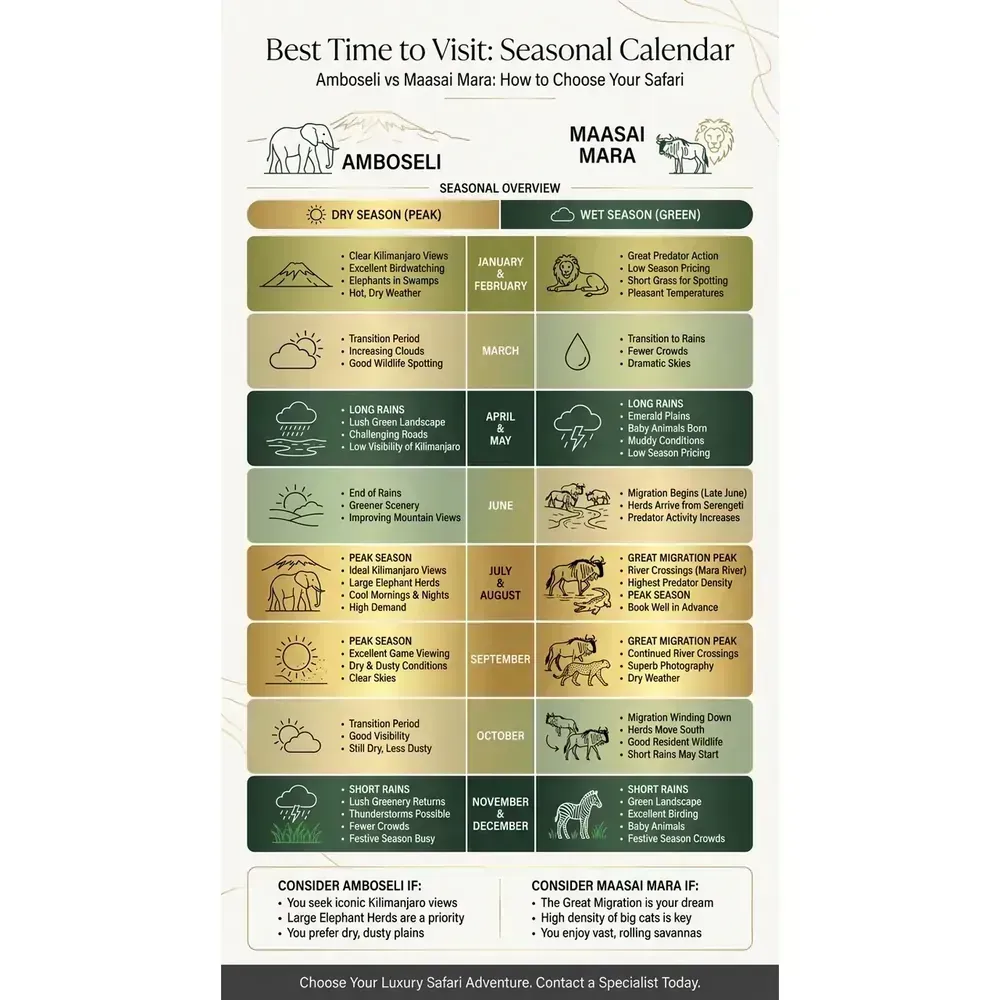
Weather and Seasons Overview
Both parks work off roughly the same seasonal pattern:
- Long rains: about late March–May – heavier rain, mud, lush scenery, fewer visitors, better pricing.
- Short rains: about late October–November – shorter showers, greener grass, dramatic skies.
- Main dry seasons: Jun–Oct and Dec–Feb – drier ground, shorter grass, better visibility, heavier demand and higher prices.
Key differences in how it feels on the ground:
- Amboseli’s shallow basin becomes very dusty and hazy late in the dry season. Great atmosphere, rough on lungs and gear.
- The Mara holds more green and diversity through much of the year, especially post‑rains. That looks fantastic on camera but comes with longer grass and more work for your guide.
Month‑by‑Month Amboseli vs Maasai Mara: Real‑Trip Outcomes
| Month | Amboseli – Visibility, Grass, Dust/Mud, Crowds, Kili | Mara – Visibility, Grass, Mud/Dust, Crowds, Migration |
|---|---|---|
| Jan | Short‑dry. Grass fairly short, visibility good. Some dust, usually clear air. Crowds moderate. Kili: often clear at sunrise in many years. | Mostly dry with a slight green flush. Grass mid‑length, viewing easy. Minimal mud. Crowds moderate. Migration: herds back in Serengeti; Mara runs on resident game. |
| Feb | Hot, mostly dry, sharp visibility. Dust rising but not extreme yet. Crowds moderate‑low. Kili: historically strong sunrise chances, but not every day. | Warm, mostly dry. Grass relatively short, clean lines of sight. Little mud. Crowds moderate. Migration: in Serengeti; resident cats and some calving in Mara. |
| Mar | Rains build. Grass greens, still manageable height. Some mud, less dust. Crowds low. Kili: mixed clouds with clear early slots. | Start of long rains. Grass grows, still fair visibility early in the month. Mud increases. Crowds low. Migration: south Serengeti; Mara is about green landscapes, not migration. |
| Apr | Peak long rains. Grass medium to tall but open terrain keeps animals visible. Mud common; no dust. Very few visitors. Kili: often hidden by clouds during the day, but you can get dramatic breaks. | Often the wettest month. Grass long in many zones; tracking cats is harder. Mud heavy in places. Very low visitor numbers, good value for those who don’t mind rain. Migration: firmly in Tanzania. |
| May | Rains ease. Grass still lush but starting to lie down. Mix of mud and drying ground. Crowds very low. Kili: often clearing more days than not late in the month. | End of long rains. Grass high but gradually flattened by herds. Some lingering mud. Crowds low. Migration: still in Serengeti; Mara is scenic and quiet with resident game. |
| Jun | Drying. Grass shortens, visibility becomes excellent. Harder ground, dust starts. Crowds edging up. Kili: crisp mornings common, useful for photographers. | Early dry season. Grass at a good viewing height; mud mostly gone. Crowds building. Migration: herds begin drifting north; may or may not touch the Mara ecosystem yet. |
| Jul | Cool, dry, short grass. Top‑tier visibility. Dust increasing but mornings often clear. Crowds moderate. Kili: strong early‑morning visibility in many seasons. | Classic dry season. Short grass, clear sight lines. Dust on roads. Crowds high, especially near predators and river loops. Migration: usually arriving in volume; some river crossings but not on a fixed schedule. |
| Aug | Very dry, dusty, midday haze. Grass very short. Animals concentrate near water. Crowds moderate. Kili: best just after dawn; haze builds later. | Peak dry. Grass cropped short, fantastic visibility. Dusty tracks. Crowds very high in main reserve. Migration: usually in full swing with frequent crossings somewhere, but never a sure thing on any given day. |
| Sep | Dry, dusty, some wind and dust devils. Visibility still strong overall. Grass short. Crowds moderate. Kili: decent sunrise shows; softer later. | Late dry season. Short grass, herds packed along rivers. Dusty. Crowds still heavy but often easing late in the month. Migration: typically still in the ecosystem; timing varies. |
| Oct | Transition. Early month stays dry and dusty; late month brings short rains, lowering haze and dust. Grass starts greening. Crowds moderate‑low. Kili: striking post‑storm views in many years. | From dry to short rains. Early Oct remains classic dry‑season viewing; later, showers and green grass return. Crowds drop after peak. Migration: herds shift toward Serengeti; early Oct can still be strong, late Oct less so. |
| Nov | Short rains. Cleaner air, far less dust. Grass green but usually not very tall. Some mud. Crowds low. Kili: dramatic skies with regular clear gaps. | Short rains. Green, moderate‑length grass; muddy patches. Crowds low‑moderate, often strong value. Migration: mainly south of the border; Mara is back to resident game plus big skies. |
| Dec | Rains ease mid‑month. Ground mixed: firm and soft. Grass green, mid‑length; viewing still good. Crowds push up over Christmas / New Year. Kili: mixed but often decent windows. | Post‑rain, fresher landscapes. Grass moderate, visibility fine. Some mud hanging around. Crowds climb over holidays. Migration: in Serengeti; Mara is about resident predators and scenery. |
In summary:
- If you are flexible and prioritise wildlife density + lower crowds, look hard at Jan–Mar and Nov–early Dec for both parks.
- If you are set on the Migration, focus on late Jul–Sep in the Mara, and accept higher prices and crowds.
- If you are photography‑driven and like moody skies, aim for Mar, Jun, Oct–Nov.
Matching Season to Your Priorities
- If your fixed point is the Great Migration, aim for Maasai Mara roughly late July to late September, and remember: river crossings are not tickets you can buy.
- For low crowds and value, look at:
- January–March or November–early December in both parks.
- April–May if you are experienced, patient, and willing to swap muddy roads for quiet sightings and lower bills.
- For cooler air and dramatic clouds, shoulder months (Mar, Jun, Oct–Nov) in Amboseli and the Mara work well. You get big sky drama over Kilimanjaro and storm‑lit savannah in the Mara, but timing and intensity vary year by year.
If you are weighing Amboseli vs Maasai Mara specifically for April–November green conditions, Amboseli usually wins on sheer visibility (flatter ground, shorter grass), while the Mara wins on atmosphere and drama but forces your guide to work harder in the long grass for cats.
Cost & Logistics: Which Park Fits Your Budget and Time?
Getting There: Distance, Flights, and Road Conditions
Typical transfer options from Nairobi (Indicative Only)
Transfer times and prices shift with fuel, operator, and season. Always get fresh numbers before locking in flights.
| Route | Mode | Approx Time | Typical One‑Way Cost (per person) | Notes |
|---|---|---|---|---|
| Nairobi → Amboseli | Road | 4–5 hours | US$60–120 (shared safari vehicle) | Paved most of the way, then rougher. Expect dust in dry months. |
| Nairobi → Amboseli | Flight | 40–50 minutes | US$150–250 | Saves your time; ideal for short safaris or those already sick of Nairobi traffic. |
| Nairobi → Maasai Mara (various airstrips) | Road | 5–6+ hours (varies) | US$70–150 | Mix of tarmac and dirt. Can be bone‑rattling and messy in rains. |
| Nairobi → Maasai Mara | Flight | 45–60 minutes | US$200–350 | Cuts out a long road slog; worth it on 3–4 night stays. |
| Amboseli → Maasai Mara (via Nairobi) | Flight + flight | Usually 3–5 hrs including connection | US$300–500 | Usually routed via Wilson Airport. Sometimes charter or via another bush strip. |
Driving is the cheaper route, especially for families or small groups using one vehicle. You pay in fatigue and lost time. Flying costs more up front but buys you more actual game drives if you only have 3–5 days to play with. That trade‑off is where many trips quietly lose value.
How Much Does a Safari Cost in Amboseli vs Maasai Mara?
Numbers below are broad ranges per person per night (double occupancy), usually including park fees, full board, and game drives, but excluding international flights and Nairobi hotels. Think of this as scaffolding, not a quote.
Amboseli – Approximate Safari Cost Ranges
| Tier | Typical All‑In pppn Range | What You Get | Value for Money |
|---|---|---|---|
| Budget | US$250–350 | Simple lodges or tented camps, shared vehicles, basic guiding | Good value for short trips; elephants don’t care if your bathroom is tiled or canvas. |
| Mid‑range | US$350–650 | Comfortable camps or lodges, better vehicles, stronger guides | Excellent balance. This is the sweet spot for most guests. |
| Luxury | US$650–1,200+ | High‑end camps, spacious tents, top guides, possibility of private vehicles | Very polished experience; often still cheaper than equivalent Mara conservancies in peak. |
Maasai Mara – Approximate Safari Cost Ranges (Indicative Only)
| Tier | Typical All‑In pppn Range | What You Get | Value for Money |
|---|---|---|---|
| Budget (main reserve) | US$300–450 | Basic camps near or just outside gates, shared vehicles, mixed guiding quality | Useful entry point; expect crowds and compromises in peak season. |
| Mid‑range (reserve / some conservancies) | US$400–900 | Solid camps, better guide ratios, some conservancy access | Most travellers should aim here. Costs spike July–October, especially in the best conservancies. |
| Luxury / Top Conservancies | US$900–1,800+ | Exclusive camps, strict vehicle limits, off‑road and night drives allowed | Expensive but delivers exceptional wildlife experiences if you can afford it. |
Amboseli vs Maasai Mara Costs in One View
Here is how per‑night bands and transfers typically shake out by tier. Again, everything moves with time; take this as directional only.
Indicative Cost Matrix (Park Fees + Accommodation + Game Drives + Typical Transfers)
| Tier | Park | Typical Park Fees (pppn)* | Typical Camp/Lodge + Game Drives (pppn) | Typical Return Transfers ex‑Nairobi | How It Feels for Value |
|---|---|---|---|---|---|
| Budget | Amboseli | Usually wrapped into US$250–350 | US$250–350 | Road: ~US$80–200 | Excellent value for a quick elephant‑rich hit. Expect simple rooms and average guiding. |
| Mara (main reserve) | Usually wrapped into US$300–450 | US$300–450 | Road: ~US$100–220 | Good value off‑peak; during migration you trade lower price for crowded sightings. | |
| Mid‑range | Amboseli | Typically bundled into US$350–650 | US$350–650 | Road or 1 return flight: ~US$150–400 | Very strong value. Stylish tents and capable guides without the “migration tax.” |
| Mara (reserve / some conservancies) | Usually bundled into US$400–900 | US$400–900 | Road or 1 return flight: ~US$200–500 | Superb wildlife with a real cost curve in Jul–Oct. Shoulder months often punch above their price. | |
| Luxury | Amboseli | Included in US$650–1,200+ | US$650–1,200+ | Typically flights: ~US$150–400 | High‑end comfort. Often feels underpriced compared to equivalent Mara conservancy levels. |
| Mara (top conservancies) | Included in US$900–1,800+ | US$900–1,800+ | Flights: ~US$200–500 | Very high nightly rates, but some of the best big‑cat viewing and vehicle management in Africa. |
To orient the wide ranges: for a typical mid‑range couple travelling outside peak Migration months, expect your all‑in nightly cost to fall toward the lower‑middle of each band. In late Jul–Sep in the Mara, expect to be closer to the upper end for equivalent quality.
How Many Days Do You Really Need in Each?
-
Amboseli:
- 2 nights – workable if you are tight on time; gives you 3–4 game drives.
- 3 nights – ideal. You get different light conditions and multiple shots at a clear Kilimanjaro.
-
Maasai Mara:
- 3 nights – minimum for first‑timers. Typically yields 5–6 drives and enough time to see multiple big‑cat interactions.
- 4–5 nights – recommended for photographers, migration hunters, or anyone splitting between reserve and conservancy.
Once you cross 5 nights in a single Mara area, consider splitting between two different conservancies rather than just stacking nights in one spot. You gain variety without much extra transfer hassle.
Which Is Better for You? Tailored Advice by Traveler Type
First‑Time Safari Travelers
For a first safari, I generally lean to Maasai Mara as your main or only park:
- High wildlife density means you see a lot fast, which matters when you have poured savings into one shot.
- The variety of species, especially big cats, gives you the “I’m in a documentary” feeling that most first‑timers quietly hope for.
Amboseli can still be the right first park if:
- You only have 2–3 days spare.
- You want less time in vehicles and a calmer environment.
- You will continue to the Serengeti, where you will get your big‑cat and Migration fix anyway.
If you can squeeze 6+ nights of proper safari, aim for a combo: 3 nights Amboseli + 3–4 nights Mara. You cover elephants, Kilimanjaro, big cats, and open plains in one hit without over‑complicating movement. Many travellers then add a third region such as Samburu or the coast to round out a full Kenya itinerary.
Wildlife Photographers
Both parks can deliver excellent work, but they lend themselves to different shot lists.
Amboseli for photographers:
- Elephants with Kilimanjaro standing behind them in first‑light colour.
- Dust plumes at golden hour; elephants kicking up haze under low sun.
- Low‑angle images from marsh edges: elephants, buffalo, and birds with mirror‑like reflections.
- Historically strong months for clear mornings and concentrated herds are Jun–Oct, Jan–Feb, but every year has its own quirks.
Maasai Mara for photographers:
- Behavioural sequences: lions on kills, cheetahs sprinting, leopards feeding or moving cubs.
- Migration work (roughly Jul–Oct most years): lines of wildebeest on ridges, crossing chaos, predators shadowing the herds.
- Dramatic weather: storm anvils, shafts of light, rain curtains, especially Mar–Jun and Oct–Nov.
- Conservancies add off‑road access and night drives, which are critical if you want low‑light or creative angles. Check each conservancy’s current rules; they are not identical.
If you are travelling mainly to shoot, I strongly advise at least 3 nights in each park, targeting shoulder or green seasons where possible to dodge peak‑season crowding around sightings. For even deeper variety across Kenya, photographers often bolt on Laikipia or Samburu after the classic Amboseli + Mara core.
Families with Children
Think about your kids’ patience rather than your own.
-
Amboseli advantages for families:
- Shorter drive from Nairobi compared with some Mara gates.
- Compact wildlife area; you find animals quickly and avoid hours of empty driving.
- Slightly calmer overall feel, which helps younger children.
-
Mara advantages for families:
- Extremely high wildlife density keeps kids engaged. There is almost always something moving.
- Many family‑friendly camps with swimming pools, family suites, and flexible dining.
For children under about 8, with only 3–4 days, I often recommend Amboseli. Less road fatigue, fewer long transfers, less chance of meltdowns. For older kids and teens, or for families who have already done one safari before, the Mara is usually the better call, ideally in a conservancy so you don’t drag them into 25‑vehicle lion sightings.
Honeymooners and Couples
For honeymoons and couples who want both drama and quiet time:
-
Amboseli offers:
- Strong dawn and dusk light over Kilimanjaro when the sky co‑operates.
- Sundowners looking across open country in relative peace.
- A slightly more low‑key atmosphere if you choose a smaller camp.
-
Maasai Mara offers:
- Intense shared moments: lions roaring in the dark, cheetahs on hunts, migrations rolling through.
- High‑end camps in conservancies with polished service, private dining setups, and often spa options.
My standard honeymoon structure: 2 nights in Amboseli + 4 nights in a Mara conservancy. You get romance, big scenery, predators, and enough time in each place without turning your trip into a logistical exercise. Many couples then fly onward to Kenya’s coast or Lamu Island for beach time to book‑end the safari.
Budget‑Conscious Travelers
If you are carefully watching every dollar:
- Amboseli often delivers more value per night at mid‑range level, especially outside Christmas and main holiday windows.
- Budget options in the Mara main reserve are tempting but often involve:
- More packed vehicles,
- Less flexible guiding,
- Camps outside the gate that require extra drive time each day.
On a tight Kenya safari budget:
- With about US$1,200–1,800 per person for your safari days (no flights), a 3‑night Amboseli trip is usually achievable without too much pain.
- With roughly US$2,000–3,000 per person, you can look at 3–4 nights in a solid Mara camp in off‑peak or shoulder months, or 3 nights Amboseli + 2 nights budget Mara if you accept compromises.
I strongly recommend mid‑range over ultra‑budget whenever you can. Better vehicles and better guides have a direct, obvious impact on what you actually see and how ethically you see it. If you want to stretch funds further, consider pairing one high‑impact park with lower‑cost days in Nairobi National Park or on the coast rather than trying to do every major park in one go.
Crowds, Ethics, and Conservancies: How Each Option Really Feels
Vehicle Density and Sightings Experience
Maasai Mara National Reserve (main reserve)
- Between Jul and Oct, top sightings like famous lion prides or river crossings can draw 15–30 vehicles at once.
- You can end up in a semi‑circle of engines, people standing up with phones, and guides pushing for better angles. It is not subtle.
Mara Conservancies
- Based on a low‑volume, high‑value model. Fewer camps, fewer beds, and set limits on vehicles using the land.
- Often enforce a cap on vehicles per sighting, with guides rotating in and out.
- Overall feel: quieter, more controlled, more respectful to the animals. Each conservancy has its own rules and those can evolve; get current details.
Amboseli National Park
- It is small and famous. You will see a cluster of vehicles near big elephant gatherings or near the best Kilimanjaro vistas.
- Overall, though, vehicle density is usually lower than in the Mara main reserve during Migration peak.
- You will not be alone, but you are less likely to be part of a 25‑vehicle scrum.
Luxury lens – where is the premium worth it?
- A high‑end camp in the main Mara reserve buys comfort and guiding, but cannot change reserve‑wide vehicle crowding or off‑road rules.
- A top‑tier Mara conservancy camp typically adds:
- Fewer vehicles at sightings,
- Off‑road access and night drives,
- More flexible timing and positioning for photography.
For a luxury traveller, that incremental spend usually translates into a noticeably better in‑the‑field experience.
Off‑Road Rules, Night Drives, and Activities
-
Mara Main Reserve:
- Generally no off‑road driving and no night drives inside the reserve.
- Main activity is daytime game drives with picnic options.
-
Mara Conservancies:
- Off‑road driving allowed under set guidelines, crucial for close big‑cat photography.
- Night drives often included, giving chances to see nocturnal species like civets, genets, porcupines, sometimes aardvark.
- Some conservancies allow guided walks.
- Policies differ by conservancy and can tighten or loosen over time.
-
Amboseli National Park:
- National park rules restrict night drives and limit off‑road driving.
- Certain camps on private or community land around the park may offer walks or night drives just outside the formal park boundary. This is camp‑specific and can change with local agreements.
How to Decide in 5 Steps
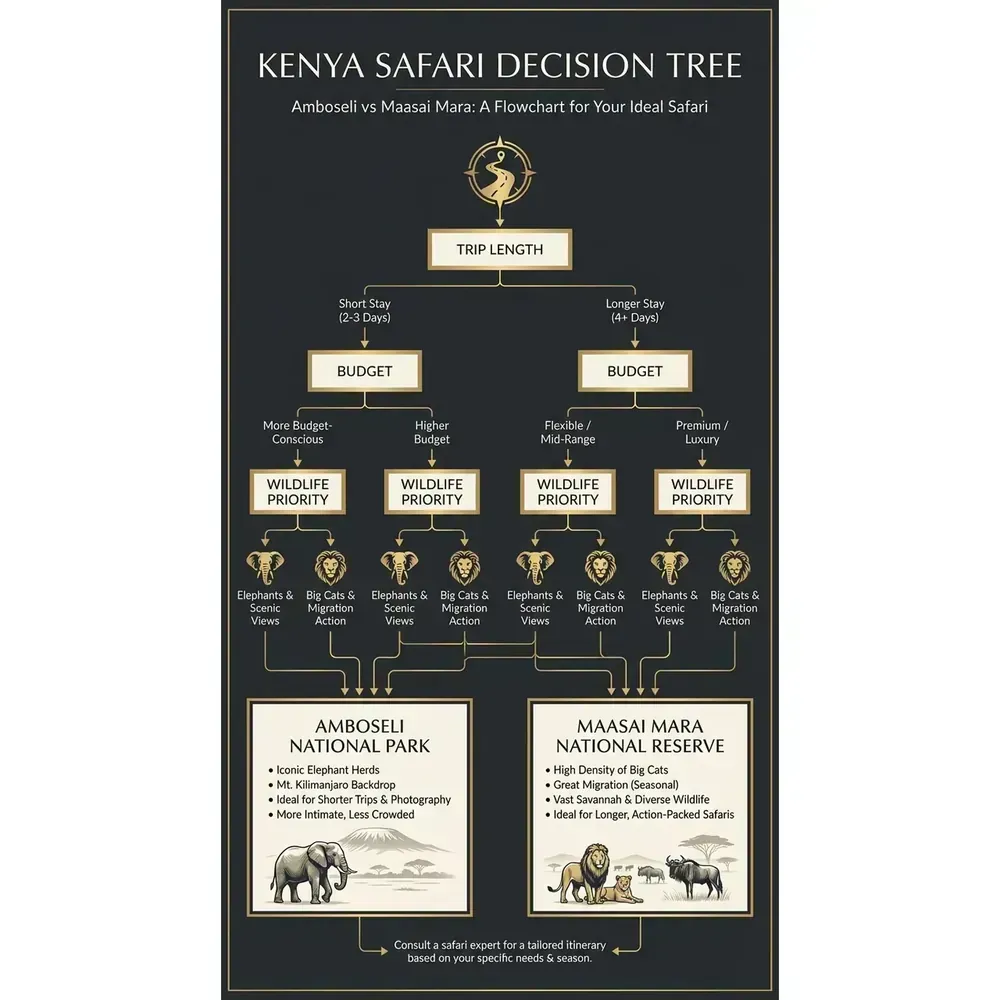
A practical decision map for when you just want the answer.
-
Lock your dates and check flexibility.
- Are you tied to one week (school holidays), or can you shift by a week or two to hit shoulder season or better weather?
-
Write down your top three non‑negotiables.
- Examples: “big cats,” “elephants,” “Migration,” “Kilimanjaro views,” “minimal internal flights,” “strict budget cap.”
-
Count your true safari nights in the bush.
- ≤4 nights: choose one park.
- 5–7 nights: either one park in depth or a very simple 2‑stop combo.
- 8–10+ nights: you can do Amboseli + Mara + one other region if you’re disciplined.
-
Match your traveller profile to the park:
- First‑timer / big‑cat fan: 3–5 nights Mara.
- Elephant or landscape‑driven, short on time: 2–3 nights Amboseli.
- Honeymoon / milestone trip (high budget): 2–3 nights Amboseli + 4–5 nights Mara conservancy.
- Budget‑sensitive: Shoulder‑season Amboseli or off‑peak Mara main reserve.
-
Commit to either one park or a clean 2‑stop plan.
- With tight time or budget, resist the urge to “collect” parks. One well‑chosen area beats two rushed visits.
- With 6–10 days and a milestone‑level budget, 2–3 nights Amboseli + 4–5 nights Mara is the configuration I recommend most often.
If you’re planning a milestone or high‑budget safari:
- Anchor 4–6 nights in a top Mara conservancy for exceptional big‑cat viewing and controlled vehicle numbers.
- Add 2–4 nights in Amboseli for elephants and Kilimanjaro if you value dramatic contrast and photography.
- Ask your operator to price two versions of the trip:
- A Mara‑only plan (reserve + conservancy), and
- An Amboseli + Mara combo,
then justify the difference in both cost and in‑the‑field experience.
Micro‑decision map (for quick orientation):
- 3–4 nights, first‑time, want big cats: Mara only.
- 3–4 nights, short transfers, elephant‑centric: Amboseli only.
- 5 nights, fixed budget, not set on Kilimanjaro: Mara only, avoid peak Migration weeks.
- 6–7 nights, milestone trip: 2–3N Amboseli + 4N Mara (conservancy‑focused).
- 8–10 nights, keen photographers: 3N Amboseli + 5–7N Mara (mix of reserve + conservancies).
- Green‑season travel (Apr–May, Nov) and crowd‑averse: Amboseli, or Mara conservancies with expectations adjusted for grass and weather.
Once you know your dates, true bush nights, and non‑negotiables, the next steps are:
- Decide single‑park vs combo using the framework above.
- Decide Mara conservancy vs main reserve if the Mara is included (or a mix of both).
- Shortlist 2–3 camps in each chosen area that:
- Match your tier (mid‑range, luxury),
- Have clear ethical and community credentials,
- Fit your style (smaller, quieter vs larger, full‑service).
- Ask us about either:
- Plan A: Mara only, or
- Plan B: Amboseli + Mara,
with a concise explanation of how each option uses your time and budget.
FAQs About Amboseli vs Maasai Mara (With a Few Myths Debunked)
Is Amboseli or Maasai Mara better for first‑time visitors?
For most first‑time safari travellers, Maasai Mara is the safer single bet. You get high wildlife density, frequent big‑cat sightings, and that classic savannah feel. Amboseli is still a strong first choice if you only have 2–3 days or if elephants and Kilimanjaro are the clear priority.
Is Amboseli worth it if I’m already going to the Mara?
Yes, if you have at least 6–7 actual safari days and a budget that can absorb internal flights. Amboseli gives you a very different mood: elephants threading across a wide basin under a huge mountain. If you only have 4–5 days door‑to‑door, stick with the Mara only to avoid turning your trip into a transfer‑heavy itinerary. You can always add contrast on a future trip with other Kenyan parks like Samburu, Laikipia, or Tsavo.
Can I realistically do both in 5 days?
You can, but the trade‑offs are poor. A typical 5‑day Amboseli + Mara run often looks like:
- Day 1: Travel + half‑day drive
- Day 2: Full day Amboseli
- Day 3: Transfers via Nairobi
- Day 4: Full day Mara
- Day 5: Morning drive + travel home
You pay for two sets of bush flights and lose two days to logistics. For 5 days, pick one park and do it properly.
How guaranteed is the Great Migration in the Mara?
It isn’t. Broadly:
- Jul–Sep are the most reliable months for herds to be in or near the Mara system.
- The exact arrival, density, and crossing behaviour change every year.
- Even with herds present, river crossings on the days you are there are not a certainty.
Think of the Migration as a moving weather system, not an event with fixed dates. If crossings matter to you, I strongly advise 4 nights minimum in the Mara and a clear head about the risk.
How often is Kilimanjaro visible from Amboseli?
You usually get your best shot at dawn, when the air is cooler and cleaner. On a 3‑night trip, you often get several solid windows, but nobody can promise a clear mountain every morning. Wet months bring more cloud; late‑dry months bring more dust and haze. Anyone guaranteeing “Kili every sunrise” is selling, not advising.
Which is better in April or November?
- April: Both parks are wet. The Mara is lush and quiet but has long grass and tough tracking. Amboseli keeps better visibility due to its open terrain. For visitors happy to deal with rain and mud, Amboseli is often more practical; the Mara is for photographers who want green and dramatic storms and are willing to work for their sightings.
- November: Short rains. Both parks green up. Amboseli’s openness keeps viewing straightforward, while the Mara looks incredible but has more cover. If you’re not chasing Migration, both can be excellent value.
Is it safe to travel between Amboseli and Maasai Mara?
Yes, if you use a reputable operator. Most people move between them using scheduled bush flights routed via Nairobi’s Wilson Airport. You will be escorted and your bags handled. Overland links between the two are long and tiring, and, in practice, rarely make sense for normal leisure travellers.
Can I self‑drive in Amboseli or Maasai Mara?
Technically, yes. Practically, I don’t recommend it for most people. Reasons:
- Tracks flood, shift, and can be confusing.
- You lose the benefit of a trained guide’s eyes and local knowledge.
- In the Mara especially, safe and ethical positioning around wildlife is a skill, not guesswork.
Guiding quality is one of the biggest multipliers of value on any safari. Don’t cut this corner to save a small percentage of the trip cost.
Amboseli vs Maasai Mara: which is better for a 3‑ to 7‑day Kenya safari itinerary?
- For 3–4 days, pick one: Mara for big cats and variety, Amboseli for elephants, Kilimanjaro, short transfers, and a calmer feel.
- For 6–7 days, a combo shines: 2–3 nights Amboseli + 3–4 nights Mara gives you two contrasting chapters without needless complexity.
If you want to see how these choices look when combined with other Kenyan regions, browse example itineraries that link Amboseli and the Mara with Laikipia, Samburu, or the coast on specialist safari planning websites or lodge group pages.
What are some good next steps once I’ve chosen my park?
- Use detailed regional guides (for example, dedicated Amboseli safari and Maasai Mara safari pages on expert tour operator sites) to shortlist 3–5 camps that match your style and budget.
- Compare at least two quotes for the same rough route so you can see how different operators allocate budget between flights, guiding, and accommodation.
- If you plan to add another area later, check how Amboseli or the Mara combine with Nairobi National Park, the Rift Valley lakes, or Kenya’s coast in terms of flight routes before fixing dates.
If you are still undecided, start with your non‑negotiables (Migration, elephants, minimal flying, firm budget) and let the weaker priorities go. That is how you end up with a clean, effective itinerary instead of a brochure‑style list of places that all deserved more time than you could give them.
Plan your Safari with Us
Let us help you plan the perfect Safari whether you want Kenya or Tanzania (or both).
Schedule your complimentary consultation below and let’s build your trip together.