

Planning a Destination Wedding starts with one unromantic truth: you are not just planning a wedding, you are running an international group travel on a fixed date with legal, religious, and financial consequences. Treat it like a project, not a fantasy weekend. This guide walks you through each step of planning a 2026-2028 destination wedding: costs, logistics, laws, risks, and how to protect the money you are about to put on the line.

1. Decide if a Destination Wedding Is Right for You in 2026
Before you fall in love with an ocean view or a stone courtyard, decide whether the destination format actually fits your life, your finances, and your family dynamics.
1.1 Key questions to ask yourselves
Run through these honestly, not optimistically:
- Are you comfortable with a smaller guest list (20–80 people instead of 150–250), even if that means some friendships cool afterward?
- If older relatives, parents with health issues, or people on tight budgets cannot travel, will you still feel okay about the choice?
- Can you handle building a trip for 30–80 people while planning your own wedding details at the same time?
- Do you want an all-inclusive destination wedding resort with set packages and rules, or are you more drawn to a custom villa or city venue that needs more organizing?
Wedding Planner advice:
If you are already worried about money, visas, and mobility for your guests, start with a domestic destination in your own country or region. Cut the paperwork, shorten flights, and reduce the odds of passport drama. If your non‑negotiable goal is a legally binding or sacramental marriage abroad, say that out loud now. We will build everything around that legal and religious framework before you pick a country, not after.
2. Choosing the Right Destination for 2026
2.1 Assess weather, seasons, and risk
For 2026, throw out the “summer vs winter” thinking. You need location‑specific data and real risk assessment, not brochure seasons.
For each region, look at:
Hurricane / cyclone seasons:
- Caribbean, Mexico, Florida: June–November, with August–October the danger zone for serious storms and airport shutdowns.
- Parts of Asia (Philippines, some Pacific islands): typhoon windows vary; you cannot guess, you need a current pattern map.
Sargassum (seaweed) on Caribbean and Mexican coasts:
- Often heavier April to October on certain stretches. It can turn a “white sand beach” into a brown line of rotting seaweed and smell strong enough to kill the vibe. Ask for recent photos by month, not stock images.
High‑wind seasons:
- Many islands and coastal spots get hard winds in winter and early spring. That affects microphones, hair, veils, and comfort. Rooftop or clifftop ceremonies can become a wrestling match with the elements.
Heat and humidity:
- Desert locations like Dubai, Caribbean summers, and Southeast Asia can hit heat indexes where standing in a full suit or layered dress for 45 minutes is medically stupid. Plan times and clothing accordingly.
My opinion:
If you want a beach ceremony with swimmable water and less weather drama, step away from peak hurricane and peak sargassum months in the Caribbean.
2.1.1 Alternative regions and seasons for 2026 Destination Wedding
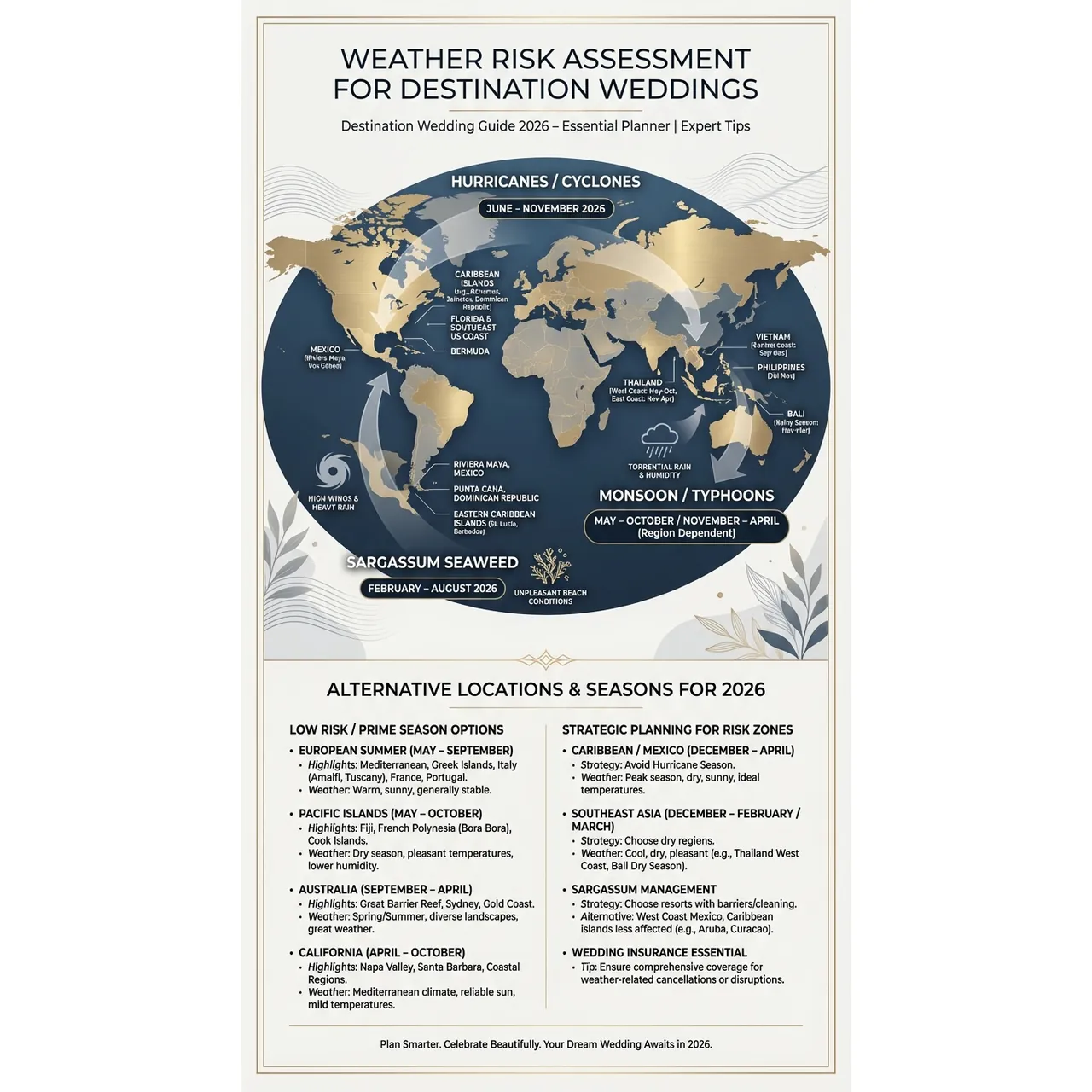
- Southern Europe: May–June or September–early October 2026
- Canary Islands: spring and autumn, when it is warm but not punishing
- Pacific Mexico or Costa Rica during periods with lower storm history
You are not just chasing sunsets. You are dodging storm maps, algae forecasts, and heat spikes.
2.1.2 Full Destination Guide
Find our full destinations guide for weddings below.
Find Our Full Destination Wedding Guides Below
2.2 Match destination type to your style
Be honest about how much control you actually want versus how much work you can realistically take on.
Resort / all‑inclusive destination wedding:
- Works well if you want predictable per‑person catering costs and simple group travel arrangements.
- Many resorts sell destination wedding packages that bundle ceremony site, reception, flowers, basic décor, and standard cake.
- You trade some creative freedom for cost control and logistics help.
City or historic venue (Italy, France, Spain, Portugal, etc.):
- Good fit if you care more about architecture, city energy, and serious food and wine than about swim‑up bars.
- Usually fully à la carte. You will hire catering, décor, rental company, transport, and coordination separately.
- Expect more contracts, more emails, and more chances for miscommunication if you do this without a seasoned planner.
Private villa or estate:
- Ideal for more intimate weddings or groups who want several days together behind one gate.
- What people forget: you must factor in tenting if needed, furniture rentals, catering equipment, portable bars, generators, staff, and the local noise rules. Some stunning villas shut down loud music at 10 p.m., full stop.
3. Understanding Legal vs Symbolic vs Sacramental Marriage in 2026

3.1 Legal requirements for a destination wedding
This is where the fantasy collides with bureaucracy. Laws vary by country, and by city, and sometimes by province. Guessing is how you end up crying over missing paperwork two days before the ceremony.
Common requirements many countries impose:
- Valid passports with at least 6 months’ validity beyond your travel dates. Anything less and immigration officers can send you back.
- Original long‑form birth certificates, sometimes with an apostille from your home country. No photocopies.
- Official divorce decrees or death certificates for previous spouses, again often apostilled and translated.
- In‑country waiting periods (2–7 days or more) before a civil ceremony. If you arrive late due to flight issues, the law does not care.
- Rules that civil ceremonies must happen in a town hall or at an authorized site, not just any romantic terrace your planner loves.
- Document translations by certified translators plus notarization or apostille stamps.
Typical cost range for legal processing abroad in 2026:
- Administration and marriage license fees: 150–$500
- Translation and apostille services: 100–$400
- Local legal liaison, agency, or planner handling paperwork: $200–$800
If you want the certificate issued abroad to be fully valid back home, verify recognition rules with your own country’s authorities before you sign anything.
3.2 Symbolic wedding ceremony
A symbolic wedding ceremony is emotionally real but legally irrelevant. For many couples, this is the most efficient pattern:
- You complete the civil marriage at home at a registry office or town hall. Twenty minutes, a small fee, done.
- You treat the destination ceremony as the “real” celebration with vows, rings, and guests, but without getting tangled in overseas law.
Benefits for 2026:
- You cut out most paperwork, translations, and apostille headaches.
- You reduce the chance that a missing stamp or missed deadline derails your trip.
- You can schedule your ceremony at any time, at any suitable location, and with any officiant you choose, not just an approved local civil officer.
3.3 Religious & Cultural Destination Weddings
| Tradition | Guides |
|---|---|
| Catholic | Catholic Destination Wedding Requirements, Destinations: Mexico, |
| Indian/Hindu | Indian Destination Weddings, Destinations: Mexico, Portugal, Spain, Italy |
| Persian | Persian Wedding in Mexico Guide |
| Jewish | Jewish Destination Wedding Guide |
| Sikh | Sikh Destination Wedding Guide (Coming Soon) |
| Muslim | Muslim Destination Wedding Guide (Coming soon) |
Wedding Planner advice:
If religious celebration is important to you and family, it will shape which countries and cities are realistic. It dictates which dates work with the parish or priest, what documents you must obtain, how far ahead you must start, and whether you need a civil wedding at home before or after the trip. Contact us for more information on venues that serve your faith.
3.4 Gay and Lesbian Destination Weddings
If you are planning an LGBTQ+ celebration it is very important to check local laws and specific policies for your venue. Contact us for our list of trusted partners.

4. Destination Wedding Costs in 2026
4.1 High-level budget ranges
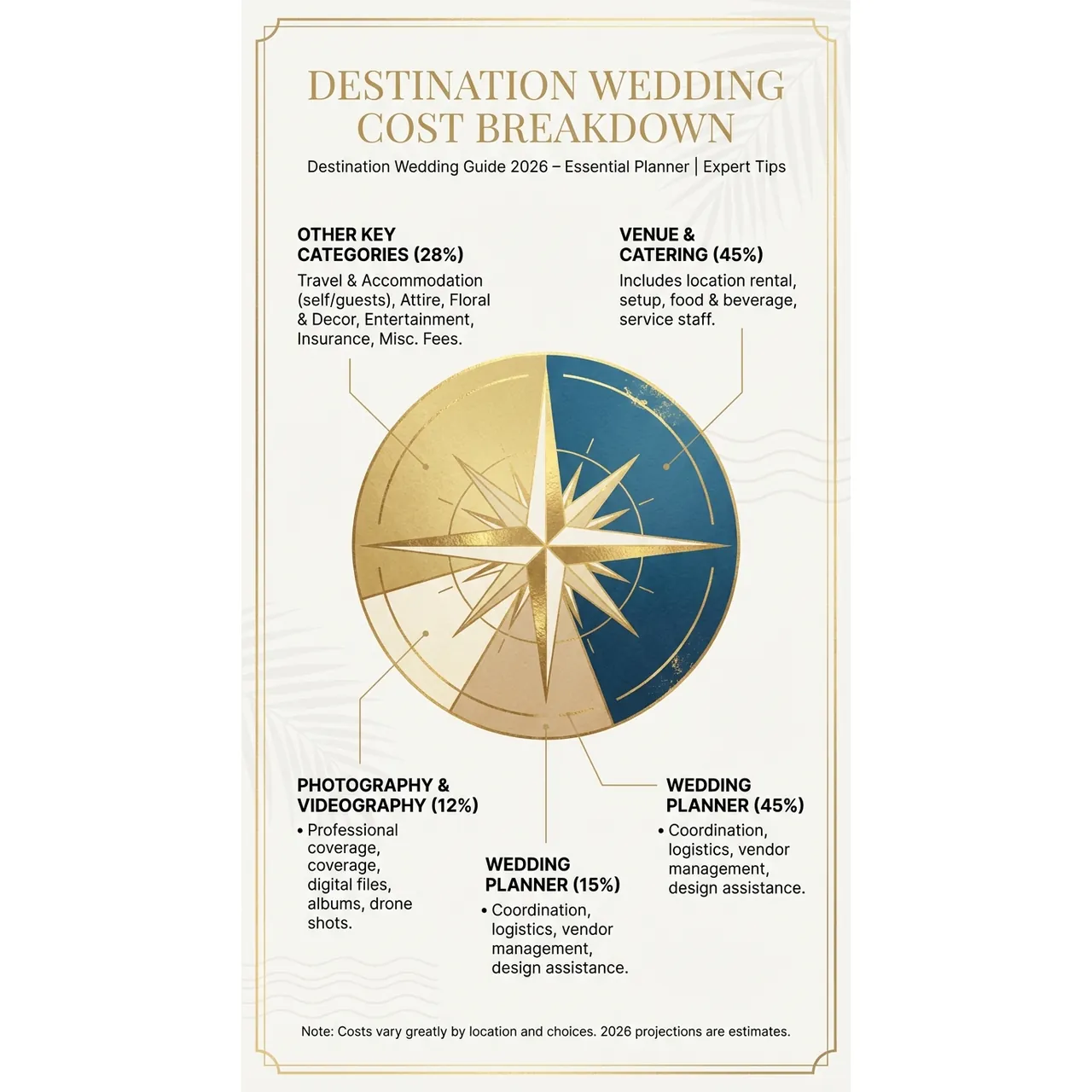
For 40–80 guests, rough destination wedding cost ranges in USD/EUR equivalent look like this:
- Compact celebration: $10,000–$20,000
- Off‑peak dates, weekday, simple décor, tighter timeline, limited entertainment hours.
- Classic destination wedding: $20,000–$45,000
- Private reception space, open bar, layered décor, professional photo/video package, DJ or band for most of the night.
- Luxury destination wedding: $45,000–$120,000
- Strong venue, top‑tier vendors, upgraded dining and bar, design‑heavy décor and lighting, and additional events like welcome party and farewell brunch.
These ranges usually do not cover guest flights. They may or may not include a few hotel nights for you, depending on the package or any perks you negotiate.
4.2 Typical line items and ranges for 2026
Build your budget around real numbers, not guesses:
- Venue rental (non‑resort): $2,000–$15,000 depending on country, exclusivity, and whether you need full buyout.
- Resort ceremony + reception packages:
- Entry‑level packages for smaller groups: *1,500–$4,000.
- More complete packages suitable for 40–80 guests: $7,000–$25,000 depending on property category and inclusions.
- Catering and bar (if not all‑inclusive):
- $80–$250 per person for food and standard drinks. Premium cocktails, tasting menus, or late‑night food push costs up.
- Photography: $2,500–$6,000, influenced by hours of coverage and reputation.
- Videography: $2,500–$5,000 for solid quality; more for high‑end teams or multi‑day coverage.
- DJ or band: $800–$5,000. A strong live band with sound engineer usually sits at the upper end or beyond.
- Flowers and décor: $1,500–$10,000+, depending on how much you layer in arches, centerpieces, candles, and ceiling work.
- Local planner / day‑of coordinator: $1,500–$6,000, higher if you expect full multi‑day logistics or complex customs.
- Hair and makeup: $250–$800 for the bride; $100–$250 per additional person, plus travel fees if your artist must move between locations.
- Legal fees and documentation: $250–$900, consistent with the earlier legal breakdown.
Do not forget “outside vendor” surcharges that resorts often impose if you bring in your own photographer, videographer, or DJ. These can quietly add $1000-$2000 per vendor and blow up otherwise tight math.
4.3 Deposit timelines and payment structure
For 2026, venues and vendors are tightening cancellation rules after recent years of disruption. Expect:
Venue / resort:
- Initial deposit of 20–30% to lock the date.
- Second installment due around 6–9 months before the wedding.
- Final balance typically payable 30–60 days before arrival, sometimes earlier for high‑demand properties.
Vendors (photographer, planner, DJ, etc.):
- Retainer of 25–50% on signing the contract.
- Remaining balance usually due 30–60 days pre‑wedding.
Wedding Planner advice:
When someone says “non‑refundable deposit,” do not nod politely. Ask: “Exactly what percentage, and from which date does it become fully non‑refundable?” For 2026 contracts, insist on clear cancellation terms and a force majeure clause that explains what happens if borders close, flights are severely disrupted, or the venue cannot operate. You want written options for date changes, credit, or partial refunds, not vague sympathy.
5. Destination Wedding Timeline for 2026
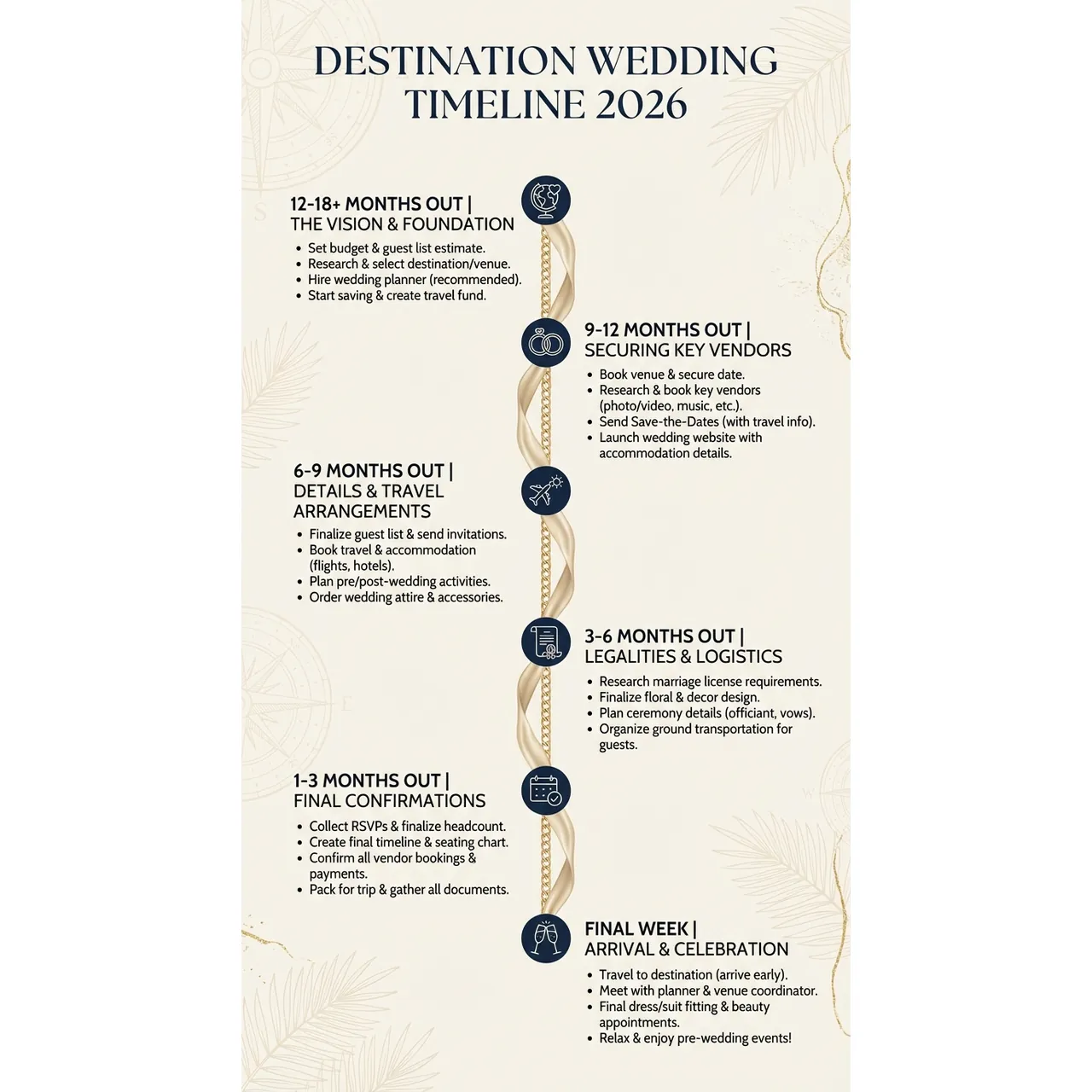
5.1 18–12 months before
Start early. The good dates and rooms disappear first.
- Choose your broader region and shortlist 3–5 destination options that match your budget and climate window.
- Decide whether your ceremony will be legal, symbolic, or sacramental. That choice dictates paperwork and lead times.
- Set a realistic budget range and an honest guest count range, not a fantasy number.
- Start talking to a destination wedding planner, like us to understand contract requirements
- Hold or reserve a tentative date based on 2026 climate data, holidays, and high/low seasons for your target area.
5.2 12–9 months before
This is when the real commitments start.
- Lock in your venue or resort and pay the initial deposit.
- Finalize your ceremony type and begin the civil or religious paperwork process with clear deadlines.
- Book key vendors: planner, photographer, videographer, music, officiant, and any essential cultural elements.
- Set up a wedding website with real travel information, not just a pretty countdown.
- Send “Save the Date” notices, especially for international guests who need time to request vacation days or renew passports.
5.3 9–6 months before
Operational details take over.
- Confirm room blocks at your resort or nearby hotels, with written rates and cut‑off dates.
- Clarify group travel arrangements and get quotes for group flight rates if most guests are coming from the same region.
- Choose preliminary menu options, compare bar packages, and start your décor design with realistic price ranges.
- Begin dress and suit fittings, factoring in heat, humidity, and movement. Heavy fabrics in tropical sun are a mistake people repeat every year.
- Give guests clear booking and deposit deadlines, plus the date when rates or availability might change.
5.4 6–3 months before
This is the phase where procrastination gets expensive, so stay ahead.
- Confirm ceremony and reception timelines with your planner and venue in writing.
- Finalize all legal documents and ensure their validity dates cover your exact 2026 wedding date. Many certificates expire after a set number of days.
- Finish any pre‑marital or sacramental requirements and confirm that documents reached the correct office.
- Approve floral plans, rental lists, AV equipment, and any upgrades for lighting or sound.
- Push for RSVPs. Late responses at this stage cost you real money in catering and room attrition.
5.5 3–1 months before
Cash flow time.
- Pay major vendor balances according to contract timelines, not whenever it feels convenient.
- Finalize seating plan, ceremony order, and readings, and share them with your coordinator or officiant.
- Provide final headcount to venue/caterer by their cut‑off date so they can order correctly.
- Reconfirm all transfer services: airport–hotel and hotel–venue, including times and passenger counts.
- Purchase or verify travel insurance and, where appropriate, event insurance that covers postponement or cancellation.
5.6 Final week and arrival
This is where airline schedules and reality meet your plan.
- Arrive 2–4 days before the wedding, or earlier if your legal process requires in‑country waiting time. Extra buffer protects you from missed connections.
- Do a full walk‑through with your planner and venue so there are no surprises about layout, lighting, or timing.
- Host a simple welcome event: group drinks, casual dinner, or beach meetup. It sets the tone and reduces guest confusion.
- Protect one clear buffer day between your travel day and your wedding day. No one looks or feels good getting married right after a red‑eye.
6. Working with Resorts and Destination Wedding Packages in 2026
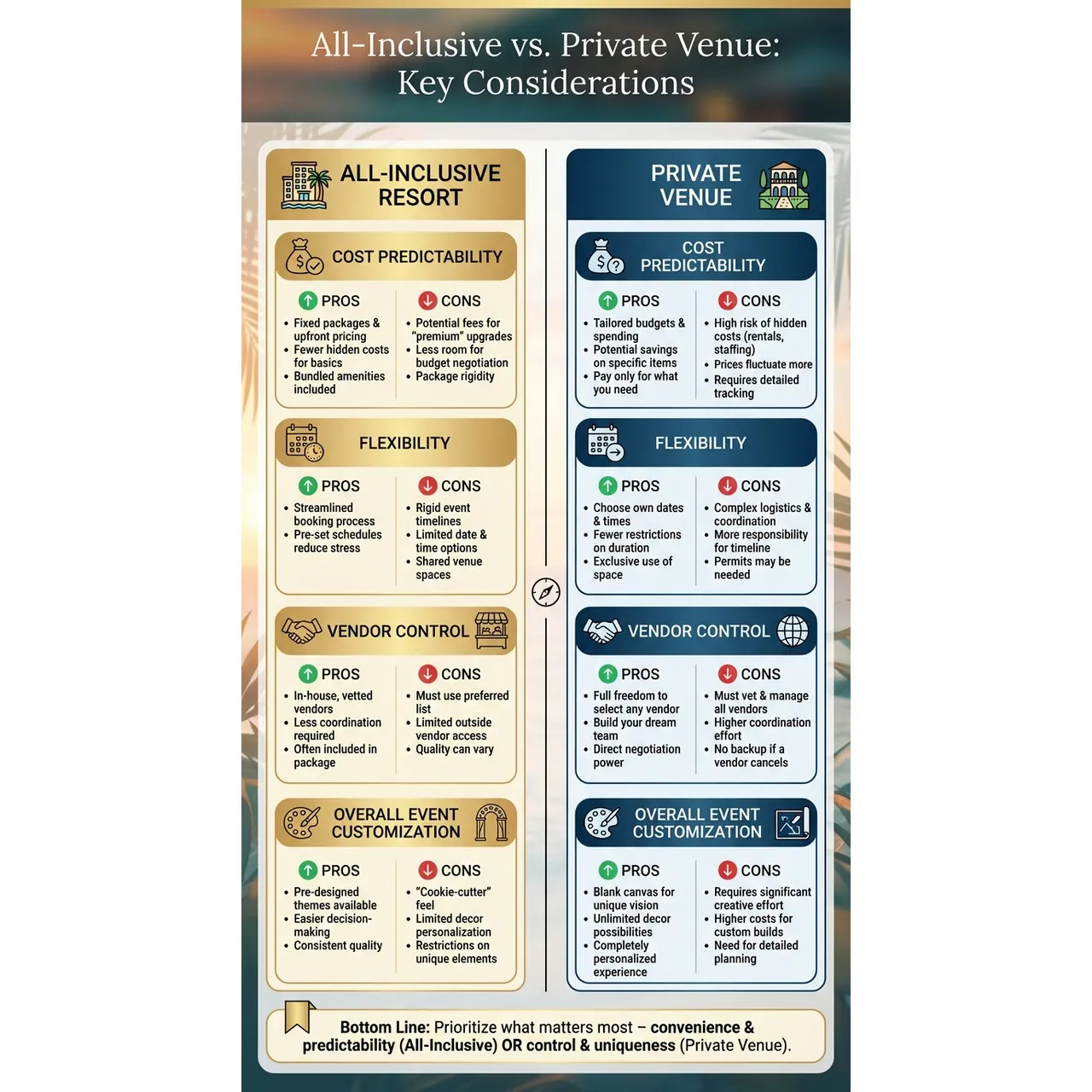
6.1 All-inclusive destination wedding resorts
An all-inclusive destination wedding can save you from nickel‑and‑diming every canapé. But you must know the trade‑offs.
Pros:
- Per‑person pricing for food and alcohol makes the budget predictable. You see quickly what each added guest costs.
- Packages often include ceremony décor, basic flowers, a sound system for the ceremony, and cake service.
- On‑site coordinators handle standard setup, basic timelines, and communication with hotel departments.
Cons:
- Standard décor can feel generic, and upgrades add up faster than you think.
- Strict rules around outside vendors. “Outside Vendor Fees” for photographers, videographers, or DJs often fall between $1000-$2000 per vendor and, in some places, more.
- Some resorts limit private event hours or enforce early music cutoffs, especially for outdoor spaces.
If you are leaning toward this route and want a deeper dive into pros, cons, and examples, read this overview of why an all‑inclusive destination wedding is a top‑tier choice.
6.2 Reading package fine print
When you compare destination wedding packages 2026, do not stop at the headline price.
You need to check:
- Whether you receive a fully private reception space or just a semi‑private corner in a restaurant with other guests nearby.
- How many hours of open bar are included, and whether premium brands or signature cocktails trigger extra charges.
- The exact outside vendor fees for each category and whether they apply even if you use local external suppliers.
- Maximum guest count included and per‑person charges above that number.
- Taxes and service charges, often 15–25% on top of the published prices, which can be a shock if you missed the fine print.
Wedding Planner advice:
If a package seems far cheaper than equivalent properties, assume a trade‑off. Usually it is privacy, flexibility, or quality of food and drink. For a wedding, you are not chasing the cheapest holiday rate. Choose a package that gives you enough flexibility to protect your top priorities, even if the initial number is higher.
Wedding Planner
7. Managing Guests, Travel, and Room Blocks
7.1 Guest communication
Confused guests will flood you with questions. Clear communication up front saves your sanity.
Information to give them early:
- Exact date range and location, with a map link so no one misbooks the wrong town that “sounds similar.”
- Recommended airports plus example flight prices for 2026 so guests can budget realistically.
- Hotel options with booking codes, group rates, and deposit and balance deadlines.
- Passport, visa, and vaccination requirements, including processing times for new passports.
- Dress code guidance and an honest explanation of climate: humidity, likely rain, and temperature range.
7.2 Room blocks and minimums
At resorts and hotels in 2026, you will see more aggressive clauses than a few years ago, so read slowly.
Typical points:
- Room blocks usually need a small deposit per room or a guaranteed number of room nights.
- Unsold rooms must be released by a set date, often 60–90 days before arrival, or you risk penalties.
- Contracts may include attrition clauses allowing you to reduce the block by a certain percentage (10–20%) without extra charges.
Wedding Planner advice:
Do not personally guarantee more rooms than you can fill. That is how couples end up paying for empty beds. Start with a realistic core block and negotiate the option to add extra rooms later at the same or similar group rate if space remains.
7.3 Group travel arrangements
You have options, but you do not have to babysit every flight.
- Group flight rates from airlines often kick in at 10+ passengers on the same route and dates. Benefits can include holdable seats while names are finalized.
- Shared airport–hotel transfers work well for guests arriving in similar time windows, saving money and confusion.
- Private transfer upgrades for elderly guests, VIPs, or those with mobility issues are worth every cent for their comfort.
Post transfer details and recommended time windows on your wedding website so guests can either join shared options or book their own confidently.
8. Weather, Risk Management, and Insurance in 2026
8.1 Weather risks you must plan around
Ignore the marketing photos. Look at actual risk factors.
- Hurricanes / cyclones: High risk in certain months and regions. Ask every venue what happened during the last major storm and how they handled it. Vague answers are a red flag.
- Sargassum: Critical on Caribbean and Mexican shores. Demand month‑by‑month photos for 2024–2025 as a guide for 2026. If they dodge the question, assume it is a problem.
- Wind and rain: Clifftop, pier, and rooftop venues look great on calm days but often need wind screens, tenting, or alternate setups ready to go.
- Heat: Plan ceremony times for late afternoon or early evening in hot regions. Midday outdoor ceremonies in August are punishment, not romance.
8.2 Backup plans
For 2026, a vague “we will move inside if it rains” is not a plan.
You need:
- A specific indoor or covered backup location for both ceremony and reception, with photos and layout confirmed in writing.
- Written rules for the weather call: who decides, when they decide, and what thresholds (wind speed, rain probability) trigger a move indoors.
- A backup photography plan if your golden hour session is washed out: covered locations, next‑morning session, or rearranged timelines.
8.3 Insurance and contractual protection
Do not assume everyone else will absorb the risk for you.
- Travel insurance: Strongly encourage guests to buy policies that cover cancellation, medical emergencies, and lost baggage. It protects them and, indirectly, you.
- Wedding / event insurance: Look at policies that cover major vendor failure, severe weather, and property damage at the venue.
- Force majeure and rescheduling clauses: Make sure every main contract states exactly what happens if flights are grounded, borders close, or the venue cannot operate. Credits, refunds, and new dates should be spelled out.
For the travel side specifically, here’s a focused breakdown of destination wedding travel insurance and what it should (and should not) cover.
9. Cultural Etiquette and Local Regulations
9.1 Local noise, alcohol, and curfew rules
Laws beat playlists. Every time.
- Some destinations enforce strict outdoor music curfews, often around midnight, sometimes earlier. After that, you move inside or turn down the volume drastically.
- Public alcohol consumption can be restricted. You cannot assume street drinking or beach bars are allowed everywhere.
- Fireworks, sky lanterns, and beach bonfires are heavily regulated in many places due to fire risk and wildlife protection. Often they are banned entirely.
9.2 Respecting local customs
You are guests in someone else’s country. Act like it.
- Ask whether modest dress is required at religious sites, and brief your guests accordingly. No one wants to be turned away at the door.
- Check for national holidays, festivals, or elections in 2026 that could clog roads, close offices, or spike prices.
- If you marry in a sacred or historic location, obey all house rules: photography limits, restricted areas, and behavior guidelines. Local backlash is not the kind of memory you want.
10. How a Specialist Planner or Travel Wedding Planner Helps for 2026
A professional planner is not just “for fancy weddings.” We an insurance policy against chaos, especially in 2026 when rules and prices change faster than social media.
We can:
- Pre‑screen venues and resorts based on your priorities, budget, and 2026 season calendars, not just glossy photos.
- Coordinate contracts, deposits, and payment timelines across multiple suppliers so you do not miss critical dates.
- Advise on legal requirements for a destination wedding in your chosen country and flag red tape early.
- Build a realistic budget, then adjust it as you make choices so there are no shock totals at the end.
- Manage guest communication, room lists, transfer schedules, and special needs so you are not fielding 50 separate emails.
- Design and run your day‑of timeline across multiple locations, giving every vendor the information they need in the language they understand.
If your time is limited, your guest count is 60+, or your destination has complicated legal or religious steps, not hiring a specialist usually costs more in stress and mistakes than their fee. If you are still weighing that decision, this comparison of a destination wedding planner vs. destination wedding travel agent breaks down who does what and when you need each.
Frequently Asked Questions – Destination Wedding guide 2026
Q1: How far in advance should we book a destination wedding for 2026?
A1: For high‑demand regions and weekend dates, aim for 12–18 months ahead. Well‑known venues and all‑inclusive resorts often lock in prime 2026 Saturdays by mid‑2025, especially in good weather windows. Smaller, weekday, or shoulder‑season events sometimes work at 9–12 months out, but the earlier you move, the better your rates, flights, and room inventory.
Q2: Is it better to have the legal ceremony at home or at the destination in 2026?
A2: For most couples, handling the civil ceremony at home is cleaner and cheaper. You avoid translation and apostille costs, in‑country waiting periods, and last‑minute surprises when an office suddenly closes for a local holiday. You then hold a symbolic or religious ceremony abroad without that pressure. If you specifically want the legal marriage in your chosen country, build in extra time and budget for documentation and a local legal contact.
Q3: What is the average cost of a destination wedding in 2026?
A3: For 40–80 guests, many 2026 destination weddings land between $20,000 and $45,000, before counting guest flights. Smaller or stripped‑back events can sit around $10,000–20,000, while high‑end celebrations at premium venues with layered décor, live entertainment, and multi‑day programming easily pass $60,000–120,000. Your three biggest cost drivers: guest count, destination, and how customized you make every element.
Q4: Who pays for travel and accommodation at a destination wedding?
A4: Standard practice: the couple pays for wedding events (ceremony, reception, and any hosted extras), and guests cover their own flights and accommodation. Some couples help with key family rooms or give a set number of resort nights as a gift. Whatever you choose, spell it out early for 2026 so guests know their financial commitment before they say yes.
Q5: How do we choose between an all‑inclusive resort and a private venue?
A5: Choose an all‑inclusive resort if you want clear per‑person costs, built‑in activities, and a simpler logistics framework where most guests stay on one property. Choose a private venue (villa, estate, or city space) if you care about a unique setting, local food, and full control of décor, and you are ready to juggle more vendors and decisions. Your budget, guest count, and appetite for hands‑on planning will point you in the right direction. For a deeper checklist of trade‑offs, see this ultimate destination wedding checklist.
Q6: What are the biggest risks for a 2026 destination wedding and how do we reduce them?
A6: The main threats are weather events (storms, extreme heat, sargassum, high winds), travel disruption, and guest cancellations. You reduce them by choosing dates with better historical weather, insisting on a serious indoor backup plan, locking in contracts with realistic rescheduling and cancellation terms, and pushing both travel and event insurance. Arriving several days early helps you absorb missed connections without blowing the schedule.
Q7: Do we really need a planner or Wedding Planner for a destination wedding in 2026?
A7: For a small, straightforward resort wedding, you may manage with a solid on‑site coordinator and some discipline. Once you move beyond that into multi‑day events, non‑resort venues, or mixed‑country guest lists of 50+ people, trying to do it entirely alone becomes a high‑risk experiment. A dedicated planner or travel Wedding Planner will usually save you money, time, and serious stress by catching the problems you do not even know to look for yet. If you are considering hiring one, this destination wedding planner services & hiring guide walks through how to vet and choose the right pro.
Partner with us for your Destination Wedding
Book an appointment below and let’s create your dream wedding together