Kenya Family Safari Guide - Best Ages, Parks & Costs
Kenya family safari planning made practical - best and worst ages, family-friendly parks, safety advice, costs and smart sample itineraries.
A Kenya family safari can be the trip your children talk about at every Christmas for the next twenty years. It can also be the week you spend trapped in a vehicle with jet-lagged kids, heat, insects, and bad logistics. The difference comes down to being honest about the children’s ages, patience levels, stamina, and safety needs.
This guide breaks down what a Kenya family safari really involves, what you are likely to pay, and how to build a kid-proof itinerary. Policies, prices, and health guidance change often, so give us a call when you’re ready and we’ll recheck everything.
To use this guide efficiently, start by matching your children’s ages to the right regions and budget band. Then shortlist two or three route options and build them out with us.
Is a Kenya Family Safari Right for Your Kids?
The Best (and Worst) Ages for a Safari
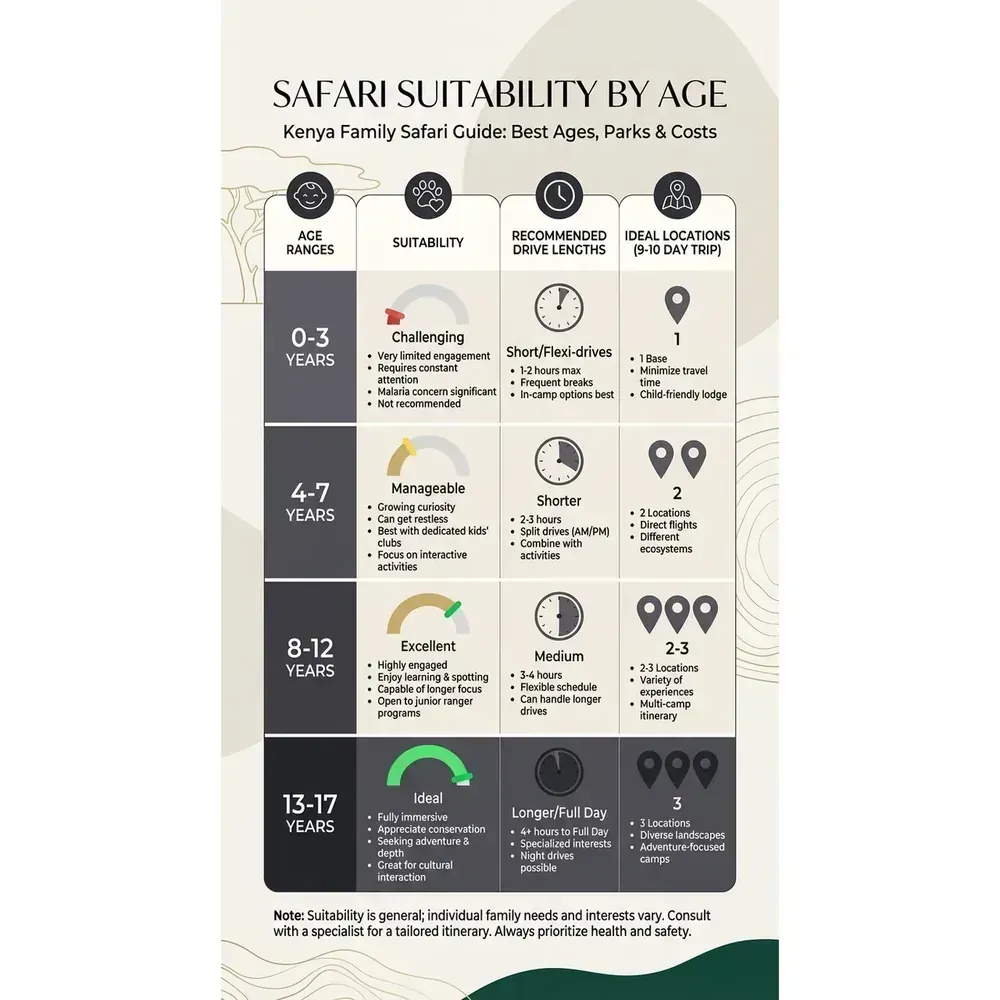
Technically, most ages can attend a safari. However, it may not be enjoyable or memorable. Here’s my rule of thumb guidance.
-
0–3 years:
I almost never sign off on a Kenya family safari at this age unless there is a specific, compelling reason and robust back-up plan.Why:
- Long-haul flights plus jet lag push most toddlers past their limits.
- Many camps do not allow very young children on game drives.
- Safety: sudden crying, bolting near wildlife, and flailing in open vehicles are not just inconvenient; they are dangerous.
- You will spend most of your safari juggling naps, snacks, and consoling upset kids, while watching other guests head out on drives.
-
4–7 years:
Possible, but only if you design the trip around them, not around your bucket list.- Pick fenced lodges or camps that openly market themselves as child-focused.
- Use bush flights to avoid the longest, roughest road stretches where practical.
- Cap drives at 2–3 hours and be ready to cut them even shorter if energy crashes.
- Choose places with pools, family rooms, and flexible kitchens that will not blink when you ask for plain pasta at 5:30 p.m.
-
8–12 years (sweet spot):
This age band is great for safaris.Why:
- They understand and respect safety rules if you take them seriously.
- They ask real questions about predators, culture, and conservation.
- They tolerate 3–4 hour drives with a stretch break and a snack.
- They love “jobs”: spotting, tracking, keeping a list of species.
-
13–17 years:
This is when you can push into the deeper end of Kenya.Think:
- Walking safaris where age limits permit, night drives, conservation visits.
- Multi-stop itineraries, early starts, and long days out in the field.
- Conversations about poaching, land use, and climate that do not go over their heads.
Age vs Suitability Table
| Age Group | Overall Suitability | Recommended Max Game Drive Length | Ideal No. of Locations in 9–10 Days | My Advice |
|---|---|---|---|---|
| 0–3 | Low | 1–2 hours (if allowed at all) | 1–2 | Hold off unless you have dependable childcare on the trip and accept you will miss most serious game viewing. |
| 4–7 | Moderate | 2–3 hours | 2–3 | Prioritise fenced lodges, short hops, and generous downtime. |
| 8–12 | High (sweet spot) | 3–4 hours | 2–3 | Go now; keep it interactive and hands-on. |
| 13–17 | Very high | 4+ hours (with breaks) | 3–4 | Layer in walking, night drives, and well-run cultural time, checking age rules per camp. |
If your children are under 4 and you are not married to a particular year, wait. You are spending serious money per day. It should buy memories they keep.
Quick age-to-region guide (first filter):
- 4–7: Nairobi + fenced Laikipia lodges; consider a carefully chosen Mara camp only with flights and strict limits.
- 8–12: Nairobi + Laikipia + Mara conservancy; Amboseli as a add-on for elephants.
- 13–17: Nairobi + a mix of Amboseli, Mara conservancy, and coast.
Use this to shortlist 2–3 route ideas before you dive into lodge brochures.
“Is It Worth Going Now or Waiting?” – By Age Band
You’ve probably been asking yourself: “If we go now, are we wasting it?”. Here’s how you can look at it.
Ages 4–7
-
Pros of going now
- Animals feel like their storybook versions that walked off the page.
- You still control the daily rhythm; they are not yet pushing for late nights or their own plans.
- A gentle, managed introduction to Africa, culture, and wildlife.
-
Cons / reasons to wait
- Patience is short. Long game drives and 5 a.m. are hard at this age.
- In ten years, they may not recall much more than “we saw lions and swam.”
- Walks, night drives, and long, high-impact sightings are often off-limits.
-
Recommended max drive times
- Road transfers: keep each stretch around 2–3 hours. If the route is longer, break it properly.
- Game drives: aim for 2 hours, occasionally 3 with a snack break and a chance to get out at a safe spot.
-
Parks/lodges to avoid or limit
- Deep-access areas that only make sense if you drive: far-flung corners of Tsavo or remote Mara sectors by road.
- Rough, unfenced bush camps where there is nothing structured for kids to do between drives.
- Itineraries that move camp every night or two with small children.
Ages 8–12
-
Pros of going now
- They soak up information about ecosystems, culture, and conservation.
- They can stick to safety rules and still show genuine excitement.
- They share sightings with you instead of retreating behind a screen.
-
Potential downsides
- They still hit a wall if you stack long days back to back.
- Some camps hold their line at 12+ for walks and more physical activities.
-
Recommended max drive times
- Road transfers: 3–4 hours with a fuel/bathroom/leg-stretch break is usually fine.
- Game drives: 3–4 hours, ideally with a bush breakfast or sundowner to split it.
-
Parks/lodges to use with care
- Very remote zones that only link by multiple long road days.
- Properties without a pool or child-friendly space if you plan more than three or four nights. Kids this age need somewhere to move.
This is the prime window. If you wait “until they’re older,” you may swap wide-eyed wonder for teenagers who are engaged but less visibly thrilled.
Ages 13+
-
Pros of going now
- You can talk about poaching, land rights, and conservation funding without losing them.
- They tolerate dawn wake-ups and long drives if they understand the payoff.
- Walks, night drives, and most conservation experiences open up, subject to the current camp rules.
-
Potential downsides
- Patchy Wi-Fi can trigger complaints.
- Some teens show enjoyment subtly; do not misread quiet as lack of engagement.
-
Recommended max drive times
- Road transfers: 4–5 hours in a day is workable if you plan breaks.
- Game drives: 4–5 hours, either as two sessions or one long, focused run.
-
Parks/lodges to avoid or limit
- None on principle. At this age, you can consider the wilder, quieter conservancies and more remote regions, provided the adults are also comfortable.
Kenya vs Other Safari Destinations for Families
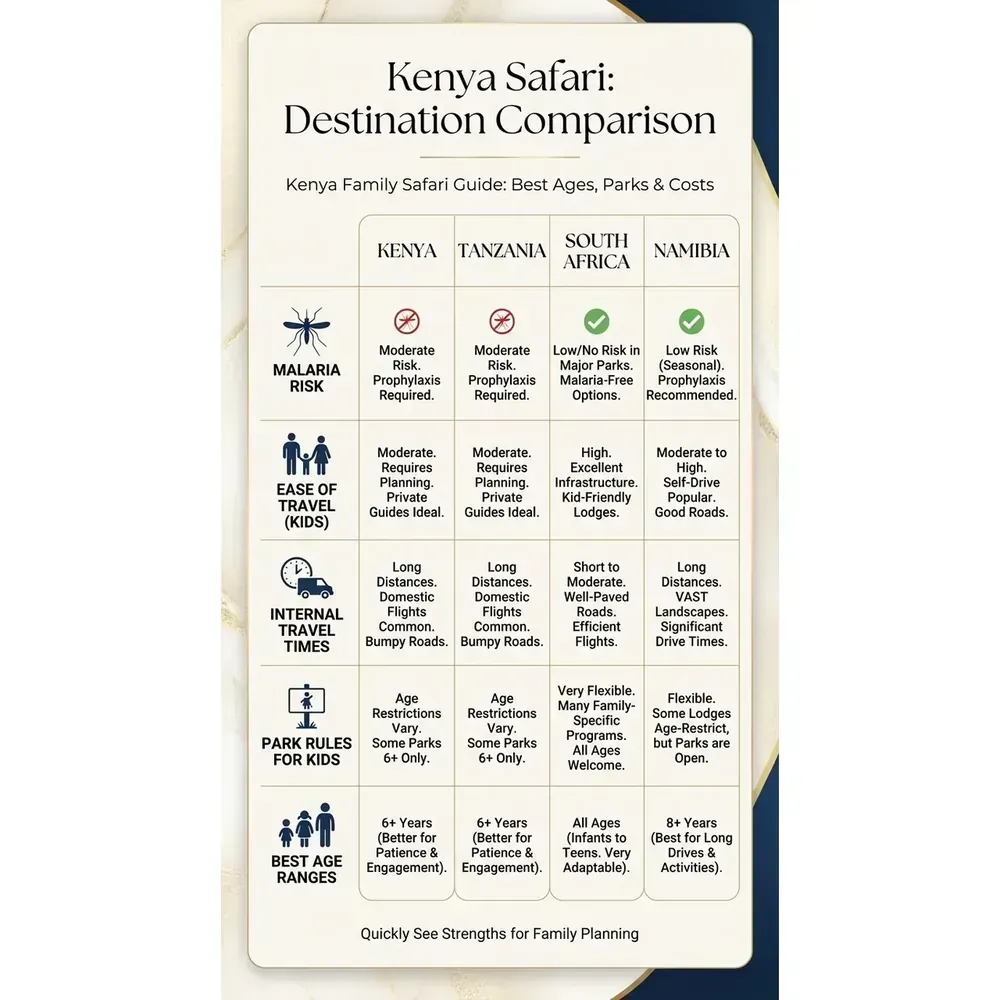
You have multiple options for a family friendly safari. Here’s a quick look at Kenya, Tanzania, South Africa and Namibia.
| Destination | Malaria Risk (main family areas)* | Ease of Travel with Kids | Internal Travel Time | Park Rules for Kids (typical, can change) | Best For Ages | When It May Be a Better First Safari Than Kenya |
|---|---|---|---|---|---|---|
| Kenya | Moderate overall; some highland areas such as parts of Laikipia and Nairobi are often described as lower, with higher risk in low-lying Mara and coast | Good: Nairobi hub, strong bush-flight network | Typical 45–60 min flights or 4–6 hr drives between key parks | Many camps welcome kids on drives; walking/night drives usually 12+ or 16+, camp-specific | 8–17 (4–7 with strict planning) | When you want concentration of big cats, access to the Great Migration, and substantial Maasai/Samburu cultural interaction. |
| Tanzania | Moderate in classic parks (Serengeti, Tarangire, Nyerere), often lower in some highlands | Good, but long road circuits are standard unless you fly | Often 5–7 hr drives between parks if overland | Similar to Kenya: vehicle activities open to kids, walks/night drives mostly 12+ or 16+, per camp | 10–17 | When you want the Ngorongoro + Serengeti circuit and can live with longer road days with older children. |
| South Africa | Many malaria-free reserves in Madikwe, Waterberg, parts of Eastern/Western Cape | Excellent infrastructure, direct flights from several regions | Usually short flights/drives from Johannesburg/Cape Town to reserves | Some lodges use minimum ages (often 6–8) for drives; many fenced with structured kids’ clubs | 4–17 | When you want malaria-free options, fences, strong kids’ programmes, and shorter internal travel with younger kids. |
| Namibia | Generally low malaria except far north and certain river areas | Moderate: good tar roads but distances are long | Long 5–8+ hr drives are normal; charter flights optional | Less formal regulation in some private lodges; emphasis on scenery over dense big-game viewing | 10–17 | When your family enjoys road trips and big desert landscapes more than close-up predators. |
Choose Kenya if…
- You want high-density big game, especially big cats and, in season, the Great Migration.
- You value guided rather than self-drive safaris.
- You are keen on meaningful Maasai and Samburu cultural interactions.
- Your children are ideally 8+, or younger but used to flying and flexible routines.
Consider South Africa if…
- You want malaria-free reserves, fully fenced properties, and structured kids’ clubs.
- Your children are 4–7 and you want shorter internal travel and predictable infrastructure.
Look harder at Namibia if…
- Your children (typically 10+) love expansive landscapes and road trips more than dense predator viewing.
- You are comfortable with long scenic drives and lighter game density.
Look harder at Tanzania if…
- You specifically want Serengeti, and your children (10+) can cope with longer transfers.
How Safe Is Kenya for Kids on Safari?
Most parents will not say this directly, but they are thinking it: “Is Kenya actually safe for my kids?” If you select the right regions, the right lodges, and a a great package, and you follow rules strictly, the answer is yes. Key safety angles to consider:
-
Wildlife Safety
- Family-focused lodges tend to be either fenced or have tight escort rules after dark.
- In unfenced camps, common in Mara conservancies and parts of Laikipia, safety depends heavily on discipline. I usually keep these for 8–10+, not toddlers.
- Non-negotiable rules for children:
- No running around camp, ever, especially at dusk or dawn.
- Stay seated in vehicles; no leaning or standing up when animals are close.
- Keep noise low when animals are nearby.
-
Health & Malaria
- Highland zones like Nairobi and substantial parts of Laikipia are often described as having lower malaria risk than low-lying parks and the coast, but “lower” is not “none.”
- Many families aiming to reduce malaria exposure combine highland conservancies and ranch areas with strict mosquito precautions.
- Risk maps are updated regularly. Book a consult with a travel doctor well ahead and go through:
- Malaria tablets.
- Routine vaccinations.
- Any yellow fever or other region-specific paperwork triggered by your routing.
-
Security & Political Context
- National parks and private conservancies typically remain stable and tightly controlled, but wider politics can shift.
- Nairobi and Mombasa are big cities. Treat them as such:
- Use arranged transfers.
- Avoid displaying high-value gadgets and jewellery.
- Follow local operator advice on where not to wander.
- Before travel, read the latest official advisories and adjust if required.
Where to Go: Best Kenya Safari Parks for Families
Quick Comparison Table of Family-Friendly Parks
Use this as a triage tool, we will find the right match for you when we chat on the phone but this guide will give you a general idea.
| Park/Region | Best For | Malaria Risk* | Travel Time from Nairobi† | Age Suitability | Highlights |
|---|---|---|---|---|---|
| Masai Mara | Big cats, Great Migration | Often higher | 45–60 min flight / 5–6 hr drive | 8+ ideal (4–7 with tight controls) | High-density wildlife, powerful sightings, quality conservancies. |
| Laikipia / Ol Pejeta | Active safaris, rhinos, highland settings | Often lower | 45 min flight / 4–5 hr drive | 6+ (8+ ideal) | Rhino work, walking (age limits), varied activities, cooler nights. |
| Amboseli | Elephants, views of Kilimanjaro | Moderate | 40–60 min flight / 4–5 hr drive | 6+ | Large elephant herds, open terrain, easy spotting. |
| Tsavo East/West | Big, wild-feeling landscapes | Moderate | 1 hr flight / 5–7 hr drive | 10+ | Red elephants, lava fields, more remote feel. |
| Nairobi NP | First-day introduction | Often lower | 20–40 min drive | 4+ | Big game near the city; ideal jet-lag softener. |
Family-Focused Park & Lodge Comparison
Masai Mara (incl. Conservancies)
| Factor | Typical Reality for Families |
|---|---|
| Age limits for activities | Game drives: many camps take 4+ (some insist on 6+). Walking: most push to 12+ or 16+. Night drives in conservancies often 12+. Always reconfirm exact rules for your dates. |
| Malaria level | Generally higher risk than many highland zones. Moist, low-lying, especially during wetter months. |
| Transfer time from Nairobi | Around 45–60 min by bush flight from Wilson; 5–6+ hours by road, depending on current road conditions. |
| Fenced or unfenced | Mix, but plenty of unfenced camps. Many conservancy camps are fully open to wildlife movement. |
| Family room options | Strong spread of family tents, interleading rooms, and private houses in established family camps. |
| Typical lodge style | Classic tented camps, often with small pools. A few formal kids’ programmes; most rely on guides who enjoy working with families. |
Laikipia / Ol Pejeta
| Factor | Typical Reality for Families |
|---|---|
| Age limits for activities | Game drives: typically 4–6+. Rhino and behind-the-scenes: often 8–12+. Walking and night drives: usually 12+ or 16+, with some exceptions. Always ask. |
| Malaria level | Many parts sit at altitude and are often described as lower risk than Mara/coast, but you still plan with prophylaxis and confirm with a doctor. |
| Transfer time from Nairobi | Around 45 min by air or 4–5 hours by road in normal conditions. |
| Fenced or unfenced | Combination of fenced lodges suited to younger kids and open, ranch-style setups. The wider Ol Pejeta conservancy is fenced for wildlife control, but lodges inside can be open or fenced separately. |
| Family room options | Plenty of family cottages, ranch houses, and interlinking rooms. |
| Typical lodge style | Ranch houses and tented camps, most with pools. Quite a few run structured “junior ranger” or conservation activities for children. |
Amboseli
| Factor | Typical Reality for Families |
|---|---|
| Age limits for activities | Game drives: often 4–6+. Walking limited; usually 12+. Night drives only in certain private areas and often 12+. Policies can shift; check per camp. |
| Malaria level | Commonly listed as moderate. Low-lying, but breezy. Prophylaxis is typically advised; your doctor has the final word. |
| Transfer time from Nairobi | Roughly 40–60 min by air or 4–5 hours by road in standard conditions. |
| Fenced or unfenced | A string of fenced lodges along the park edge; some unfenced tented camps in private concessions. |
| Family room options | Good spread of family chalets and rooms, often in landscaped gardens. |
| Typical lodge style | Conventional lodge structures, pools, lawns. “Resort in the bush” feel that tends to be easy on younger children. |
Tsavo East & West
| Factor | Typical Reality for Families |
|---|---|
| Age limits for activities | Game drives: usually 6+, though a few take 4+. Walking often 12+ or 16+ and limited. Night drives in certain private areas, again often 12+. Always check current age rules per property. |
| Malaria level | Generally seen as moderate, with higher exposure near watercourses and dams. |
| Transfer time from Nairobi | Around 1 hr by air or 5–7 hours by road, plus coastal connections where relevant. |
| Fenced or unfenced | Both exist: some older hotels are fenced; many smaller camps are unfenced and feel very wild. |
| Family room options | A mix: some big lodges have family rooms; fewer sleek “designer” family suites than in the Mara or Laikipia. |
| Typical lodge style | Larger, sometimes older properties alongside character camps. Expect pools and big open grounds but limited formal kids’ clubs. Better for older kids who do not need constant programming. |
Nairobi & Surrounds (Nairobi NP, Karen area)
| Factor | Typical Reality for Families |
|---|---|
| Age limits for activities | Nairobi NP drives work well for 4+. Giraffe Centre and elephant orphanage are usually ideal from 4–12; you must check current entry and age policies. |
| Malaria level | Highland city setting often considered lower risk, but verify with a travel clinic. |
| Transfer time from airport | Around 20–40 min, traffic depending. |
| Fenced or unfenced | City hotels and suburban lodges are fenced and secure. |
| Family room options | Wide range of interconnecting rooms, suites, villas. |
| Typical lodge style | Boutique city hotels and green suburban retreats with gardens and pools. Ideal decompression stop. |
Masai Mara – Classic Big Five and the Great Migration
The Masai Mara is the poster child for a Kenya safari with kids for a reason.
You get:
- Dense concentrations of lions, cheetahs, hyenas, and grazers.
- From roughly July to October, massive herds of wildebeest and zebra as the Migration spills in, though exact timing shifts year by year.
- Private conservancies like Mara North, Naboisho, Olare Motorogi that:
- Curb vehicle numbers.
- Allow night drives and, where rules allow, walking.
- Offer flexibility, such as private vehicles, which matter a lot with kids.
Trade-offs:
- Main-reserve river crossings in high season can be chaotic, with too many vehicles and impatient drivers. You will not want a small child in the middle of that.
- Malaria risk here is material; you do not improvise on prophylaxis or net use.
- Many camps are unfenced, which feels magical for older children but is a poor match if you are chasing a three-year-old around.
I steer families toward:
- 8–12-year-olds and teens, particularly into conservancies where you can combine serious game viewing with flexible rules.
- 4–7 year olds only when:
- You pick camps that are managed with children in mind and preferably have secure perimeters or tightly controlled grounds.
- You go for shorter drives and accept that you might forgo the most intense sightings if your child starts to struggle.
Laikipia & Ol Pejeta – Great for Active Families
Laikipia and Ol Pejeta give you one of the cleanest combinations for families: strong wildlife, conservation depth, and, in many areas, cooler highland air with fewer mosquitoes than the lowlands.
You typically get:
- Serious rhino work and endangered species projects.
- Varied terrain, from open plains to bush and river lines.
- Activities that actually burn energy:
- Camel or horse rides in some private reserves.
- Cycling or mountain biking where operators allow.
- Night drives and walking, often with age floors.
Laikipia fits:
- 8–12-year-olds who want to do things, not just sit in a vehicle.
- Teens who can engage with complex conservation stories rather than just ticking species.
If you want one region that tends to reduce malaria exposure and adds hands-on elements, this is where I start sketching.
Amboseli – Easy Big Tusker Viewing
Amboseli is where you go if you want your children to understand elephants, not just see them.
Expect:
- Big breeding herds and, if you are lucky, old bulls with substantial tusks.
- Open swamps and plains that make spotting child-friendly. You are not peering through thick bush hoping for a glimpse.
- On a clear day, Kilimanjaro sits behind the scene like a painted backdrop.
Practical pieces:
- Access is manageable by road or short flight, giving you options for different budgets.
- Many families pair it with Tsavo or swing between Amboseli and the coast.
- Malaria risk sits in the middle ground; you still treat it seriously and discuss tablets with your doctor.
Amboseli works well for 6+ when you want big, visible animals and nothing too complex.
Tsavo East & West – Off-the-Beaten-Path Adventures
Tsavo is for families ready for more space and less predictability. If your kids demand constant, guaranteed action, pick carefully.
What it offers:
- Tsavo East: big open spaces, red dust, and elephants the colour of the soil.
- Tsavo West: rougher, rockier terrain, springs, and striking lava flows.
Strengths:
- Low visitor density. You feel the scale and the quiet.
- Strong sense of exploration instead of a set-piece game-drive circuit.
Costs:
- Wildlife is more spread out. You work harder for sightings and you do not always “win.”
- Distances are longer, both between Nairobi and the parks and between some camps.
I tend to reserve Tsavo for children around 10+ who already enjoy wild places and can handle longer, less “guaranteed” days.
Nairobi National Park & Giraffe/Elephant Centers – Gentle Introduction
Nairobi is not just somewhere to crash after the flight. Used properly, it can stop your family burning out on day one.
Use it for:
-
Nairobi National Park:
- Short drives among real big game with the city skyline in the distance.
- Jet-lagged children can see rhino and giraffe without a long bush flight.
-
Giraffe Centre:
- You feed giraffes at eye level. Younger children, especially, rarely forget it.
- Works well for 4–10-year-olds.
-
Sheldrick Wildlife Trust (elephant orphanage):
- Supervised sessions watching orphans feed and play in the mud.
- Needs advance booking; visitor rules change from time to time.
I advise most families, especially with younger kids, to schedule 1–2 nights in Nairobi so bodies adjust before you attempt full bush days.
How Much Does a Kenya Family Safari Cost?
Transparent Family Budget Examples (7–10 Days)
These examples assume a family of four (2 adults, 2 children), not counting your international flights. They show how route and style quietly change the total.
7-Day / 6-Night Kenya Family Safari – Nairobi + 1 Park
(All nights are nights on the ground in Kenya.)
| Level | Typical Trip Style | Rough Total for 4* | Usually Includes | Common Extras |
|---|---|---|---|---|
| Budget | 1 night Nairobi + 5 nights in one park (Mara or Amboseli), simple lodge, shared vehicle, road where sensible | ≈ $12,000–$20,000 | Lodge stays, safari meals, scheduled game drives, park fees, basic transfers | Drinks, tips, visas, medical costs, some activities (such as balloon flights), Nairobi meals/entries |
| Mid-range | 1 night Nairobi + 3 nights Laikipia + 3 nights Mara, mix of road and 1–2 flights, some family suites | ≈ $15,000–$25,000 (indicative) | As above plus internal flights, better service standards, laundry at many camps | Premium drinks, specialist activities, upgraded childcare, insurance |
| Luxury | Boutique Nairobi + 3 nights Laikipia + 3 nights Mara conservancy, full fly-in, private vehicle | ≈ $25,000–$4,000+ (indicative) | Top-end camps, all bush flights, private guiding, most drinks, park fees | Balloon flights, larger tipping budgets, shopping, bespoke add-ons |
-
Visas:
- Costs vary by nationality, historically sitting around $30–$100 per person.
-
Vaccinations & malaria prophylaxis:
- Cost ranges are wide, but for a family, budget at least several hundred dollars. A travel clinic will give you current prices and timing.
-
Optional extras:
- Balloon rides: usually $450–$600 per person, sometimes with 8+ or 12+ age limits.
- Horse riding, specialist conservation visits: commonly $50–$200+ per person.
-
Travel insurance and evacuation:
- Comprehensive cover with medical, cancellation, and evacuation can sit around $150–$400 per person, depending on age and benefits.
Typical Camp Safety Measures
Good camps run safety systems almost invisibly. Still, you should understand how they work.
Most will have:
-
Physical measures
- Fences or natural barriers around family-suitable lodges.
- Nets on beds, screens on windows.
- Lighting on paths and sometimes raised walkways.
-
Operational measures
- Mandatory escorts between room and common areas after dark in unfenced camps.
- Radios in vehicles and at key posts.
- Staff trained to monitor and respond to animal movements near camp.
-
Child-focused measures
- Clear rules on where children can and cannot wander.
- Earlier mealtimes, often in separate areas so children can eat and sleep at sensible hours.
- Policies requiring younger children to be with an adult even in daylight in unfenced properties.
Food, Water, and General Hygiene
Most mid-range and luxury safari outfits understand that one sick child derails a camp atmosphere fast, so they take food hygiene seriously.
- Drink bottled or filtered water only.
- Are cautious with street food for children unless someone local and trusted steers you.
- Remind children not to brush teeth with tap water unless the camp confirms it is safe.
Pack:
- Familiar non-perishable snacks to keep blood sugar stable.
- Oral rehydration salts as insurance against stomach upsets.
- Child-safe painkillers, antihistamines, plasters, and antiseptic wipes.
Tell your operator about allergies early and then confirm them again when you check in to each camp.
What to Pack for a Kenya Family Safari (With Kids)
Clothing and Gear Essentials
Per person:
- 2–3 pairs of light, neutral trousers.
- 3–4 breathable shirts; some long-sleeved for sun and insects.
- Light fleece or jacket for cool dawns and nights.
- Trainers or sturdy walking shoes plus sandals.
- Wide-brimmed hat.
- Sunglasses with UV protection.
- Swimwear.
Shared gear:
- At least one decent pair of binoculars; ideally a second, child-friendly pair.
- Power banks and universal adapters.
- Camera or well-protected smartphones.
- Zip bags for dust and organising small items.
Most mid-range and luxury camps offer laundry and many amenities, so you can pack lighter than you think. Bush flights have weight limits and arguing at check-in helps no one.
Kid-Specific Items That Make a Big Difference
Small things buy big peace:
- Non-melting snacks they already like.
- Comfort items (soft toy, blanket, pillow).
- Activity books, sketch pads, colouring pencils.
- Card games and robust travel games.
- Child-proof camera or instant camera with enough film.
- Pre-loaded audiobooks or shows.
If you are going to overpack anything, let it be small distractions and patience.
Frequently Asked Questions About Kenya Family Safaris
Q: What is the best age for kids on a Kenya family safari?
A: Typically 8–12. They remember it, understand rules, and handle the drives. Teens are excellent for more adventurous routes. With under-4s, you usually get poor value for money unless your expectations are extremely modest.
Q: How long should a Kenya family safari be with children?
A: For most families, 7–10 days on the ground, including an arrival night in Nairobi, works well. Younger children often do better with 7 nights and fewer stops. Teens can handle 10–12 nights, particularly if you add beach time at the end.
Q: Can we combine a Kenya family safari with beach time?
A: Yes, and many do. A common structure is 5–7 nights safari + 3–4 nights coast. Remember that Kenyan coastal areas generally carry higher malaria risk than some highland regions, so discuss this with a travel doctor and factor it into your route.
Q: How much does a 7-day Kenya family safari cost for a family of four?
A: As rough guidance at the time of writing, a 7-night safari for four in Kenya often lands around $8,400–$14,000 at the budget level, $15,000–$24,000 for mid-range, and $28,000+ for high-end, excluding international flights. Those are indicative only; always confirm updated figures for your travel year.
Q: Is Kenya safe for a family safari with young kids?
A: With the right camp choices, routing, and operator, yes. You focus on fenced or strongly managed properties, use flights where possible instead of long road legs, follow wildlife rules tightly, and handle malaria prevention properly. With under-4s, I generally advise either waiting or restricting yourselves to relatively lower-risk, more structured environments.
Q: Is tipping expected on a Kenya safari with children?
A: Yes. Plan around $10–$20 per guest per day for the main guide and $5–$15 per guest per day for camp staff. Some lodges publish suggested ranges. Tip discreetly and in the recommended currencies.
Q: Can kids use drones on a Kenya family safari?
A: In practice, no. Most parks and conservancies ban drones without permits, and tourist permits are rarely granted. Drones disturb wildlife and other guests. Assume all drone use is off the table.
Plan your Safari with Us
Let us help you plan the perfect Safari whether you want Kenya or Tanzania (or both).
Schedule your complimentary consultation below and let’s build your trip together.